Introduction
Why sleep matters for emotional, mental and physical wellbeing, and practical ways to build healthier sleep habits without turning bedtime into another source of stress.
Sleep is one of the most fundamental parts of human life.
We spend roughly a third of our lives sleeping, yet many people treat sleep as something that can be sacrificed whenever life becomes busy.
A late night here.
An early morning there.
Work continuing into bedtime.
Time on the phone when we should be winding down.
And eventually, poor sleep can begin to feel normal.
In my experience of working with people across different aspects of health, sleep is often one of the most underestimated foundations of wellbeing. People may focus intensely on diet, exercise, supplements or medical treatments while overlooking something their body needs every day.
Rest.
Sleep is not simply a period when the body switches off.
During sleep, the brain and body continue to perform important functions involved in restoration, memory, emotional processing, metabolism, immune function and many other physiological processes.
At the same time, sleep and mental wellbeing influence each other.
Stress can make it difficult to sleep.
Poor sleep can make stress harder to manage.
Worry can keep the mind active at night.
And repeated poor sleep can affect mood, concentration, energy and the ability to cope with everyday challenges.
Understanding this relationship can help us approach sleep more intelligently, and more compassionately.
What Is Sleep?
Sleep is a naturally recurring state involving changes in consciousness, brain activity, movement, breathing and physiological regulation.
It is not a passive state.
The brain moves through different stages of sleep, broadly including:
- Non-REM sleep
- REM sleep
These stages occur in cycles throughout the night.
Different stages are associated with different patterns of brain and body activity.
Sleep therefore involves an organised biological process rather than simply “resting with your eyes closed.”
Why Do We Need Sleep?
Sleep supports many aspects of health.
Adequate, good-quality sleep is associated with healthy:
- Attention
- Learning
- Memory
- Emotional regulation
- Physical recovery
- Metabolic function
- Immune function
- Daily energy
- Overall wellbeing
The exact amount of sleep needed varies with age and individual circumstances.
For most adults, regularly obtaining around 7–9 hours is a useful general reference, although individual needs differ.
More important than chasing a perfect number is understanding how your sleep pattern affects your functioning.
If you regularly wake unrefreshed, struggle to stay awake during the day, or experience persistent difficulty sleeping, the issue deserves attention.
Sleep and the Brain
One of the clearest relationships between sleep and mental wellbeing can be seen in cognitive function.
Poor sleep can affect:
- Attention
- Concentration
- Reaction time
- Decision-making
- Memory
- Learning
- Mental flexibility
After one particularly short night, you may notice that you are less focused or more irritable.
When insufficient sleep becomes chronic, these effects can become more significant.
This is one reason I encourage people not to view sleep as “lost time.”
Sleep is part of the time your body uses to maintain itself.
Sleep and Emotional Regulation
Have you noticed that problems sometimes seem much larger after a sleepless night?
A difficult conversation may feel more overwhelming.
A small frustration may produce a stronger emotional reaction.
It may become harder to step back and respond calmly.
Sleep and emotional regulation are closely connected.
Adequate sleep does not eliminate difficult emotions, but healthy sleep can support the brain’s ability to regulate attention, emotion and responses to stress.
This becomes especially important when someone is already going through a demanding period of life.
The Relationship Between Stress and Sleep
Stress and sleep can create a cycle.
For example:
Stress → racing thoughts → difficulty sleeping → fatigue → reduced coping capacity → more stress
This can become frustrating because the person may begin worrying about sleep itself.
“What if I don’t sleep tonight?”
That thought can create more alertness.
The more we force sleep, the more difficult it may become.
A healthier approach is often to create conditions that support sleep rather than trying to command yourself to fall asleep immediately.
Why Does the Mind Become More Active at Night?
During the day, attention is occupied by work, conversations, responsibilities and external stimulation.
When the environment becomes quiet at night, thoughts that were pushed aside during the day may become more noticeable.
You may suddenly begin thinking about:
- Tomorrow’s tasks
- Family concerns
- Financial worries
- Health
- Relationships
- Work
- Past conversations
- Future possibilities
This does not necessarily mean that something is wrong with you.
The quiet of nighttime can simply make internal mental activity more obvious.
Developing a transition between daytime activity and bedtime can help.
Your Circadian Rhythm: The Body’s Internal Clock
Sleep is influenced by a biological timing system often called the circadian rhythm.
Light and darkness are important environmental signals.
Regular exposure to morning light and a reasonably consistent sleep–wake schedule can help support a stable circadian rhythm.
Irregular schedules, late-night light exposure and frequent changes in sleeping times can make sleep timing more difficult for some people.
This is one reason consistency can be helpful.
You do not need to wake at exactly the same minute every day.
But a broadly predictable rhythm can be beneficial.
Morning Light and Sleep
One of the simplest sleep-supporting habits is to get appropriate natural light during the morning.
Morning light provides an important environmental signal to the body’s biological clock.
If possible:
- Spend some time outdoors after waking.
- Open curtains and allow daylight into your surroundings.
- Combine morning light exposure with a gentle walk when practical.
This is not a magical treatment for insomnia.
It is simply one healthy environmental cue that can support circadian timing.
Screens, Phones and Bedtime
Modern technology has changed the way we spend our evenings.
A phone can bring:
- Work messages
- News
- Social media
- Entertainment
- Financial information
- Conversations
- Endless scrolling
Even when the screen itself is not the only reason for poor sleep, stimulating content can keep the mind engaged when it should be winding down.
If you struggle with sleep, experiment with creating a period before bedtime when your phone is no longer the centre of attention.
You might:
- Reduce unnecessary notifications.
- Avoid stressful conversations immediately before bed.
- Keep work outside the bedroom where practical.
- Replace endless scrolling with quiet activities.
- Dim the environment as bedtime approaches.
The goal is not technological perfection.
It is reducing unnecessary stimulation.
Create a Sleep-Wind-Down Routine
The body benefits from signals that a transition is occurring.
A simple evening routine might include:
Dinner → gentle activity → reduced stimulation → personal hygiene → quiet reading or breathing → bed
The exact routine does not matter as much as consistency.
You might include:
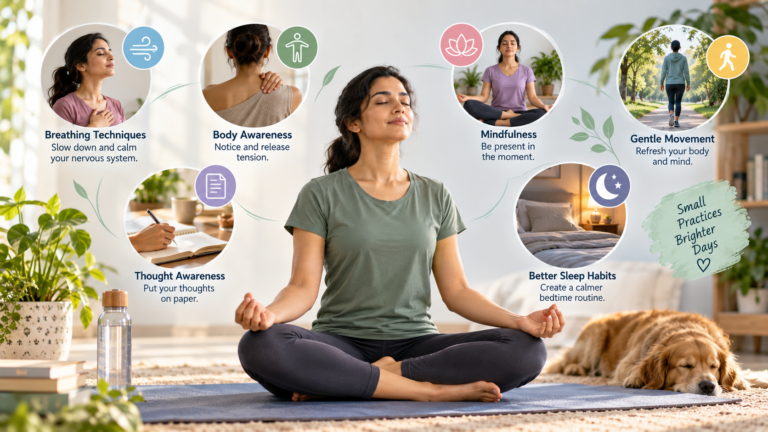
- Gentle stretching
- Slow breathing
- Reading
- Journaling
- Meditation
- Quiet music
- A warm shower
- Gratitude reflection
Choose something that genuinely helps you settle.
What If I Cannot Fall Asleep?
This is where many people become trapped.
They lie in bed looking at the clock.
Then they calculate how many hours remain before morning.
Then they become anxious about being tired tomorrow.
Then sleep becomes even harder.
If you are awake for a prolonged period and becoming increasingly frustrated, getting out of bed for a quiet activity under dim light may sometimes be more helpful than remaining in bed feeling increasingly tense.
Return to bed when you feel sleepy again.
The exact strategy may vary, particularly for people with persistent insomnia.
Don’t Turn Sleep Into Another Performance
This is an important principle.
There is a growing culture of sleep optimisation:
- Sleep trackers
- Perfect bedtime routines
- Supplements
- Special foods
- Complicated sleep protocols
- Continuous monitoring of sleep scores
Technology can provide useful information.
But excessive monitoring can also make some people anxious about whether they are sleeping “correctly.”
Remember:
Sleep is a biological process, not an examination.
Your goal is not to achieve a perfect score.
Your goal is healthy, restorative sleep as part of a balanced life.
Sleep and Exercise
Regular physical activity is associated with many health benefits and can support healthy sleep for many people.
Walking, cycling, swimming, strength training, yoga or other suitable forms of exercise can become part of a healthy routine.
However, intense exercise immediately before bed may feel stimulating for some individuals.
Pay attention to your own response.
The bigger principle is:
Move your body regularly during the day.
You do not need a complicated exercise programme to begin.
Yoga, Relaxation and Sleep
Yoga offers several practices that may fit naturally into an evening routine.
Depending on your ability and preferences, this may include:
- Gentle stretching
- Comfortable postures
- Breath awareness
- Relaxation
- Meditation
- Yoga nidra or guided relaxation practices
The purpose should be to encourage relaxation and body awareness rather than to force sleep.
If a particular practice makes you more alert, choose something gentler or move it earlier in the day.
Yoga is not a replacement for evaluation and treatment of a sleep disorder.
Breathing and the Transition to Sleep
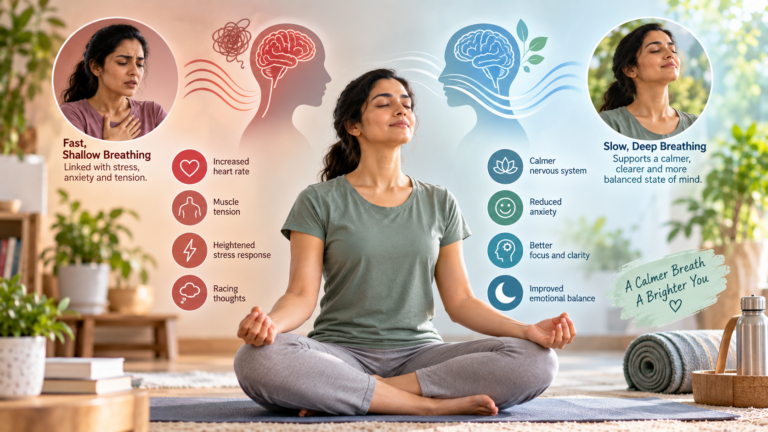
Breathing provides a simple anchor for attention.
Before bed, you might sit or lie comfortably and observe your natural breathing for a few minutes.
Rather than forcing deep breaths, begin by simply noticing:
- The movement of the abdomen or chest
- The temperature of the breath
- The rhythm of inhalation and exhalation
- Areas of tension in the body
If comfortable, allow the exhalation to become relaxed and unhurried.
The purpose is not to achieve a special physiological state.
It is to shift attention away from constant mental activity and toward present-moment awareness.
For more on this subject, see: MB-008 — Breathing Patterns & States of Mind.
Meditation and Sleep
Meditation is sometimes described as a way to “switch off the mind.”
I prefer a different understanding.
Meditation does not require you to stop thoughts.
Thoughts will come.
The practice is learning to notice them without automatically following every thought.
For example:
“I need to solve this problem right now.”
You can notice that thought.
Then return attention to your breathing, bodily sensations or another chosen focus.
Over time, this kind of attentional training may support greater awareness and relaxation.
However, meditation should not be presented as a universal treatment for insomnia or mental health conditions.
Persistent sleep difficulties may require structured clinical treatment.
Sleep and Food
What and when you eat can influence sleep indirectly.
Heavy meals close to bedtime may cause discomfort or reflux in some people.
Caffeine can interfere with sleep, particularly when consumed later in the day.
Alcohol may make some people feel sleepy initially but can disrupt normal sleep patterns.
Individual responses differ.
If sleep is a problem, observe whether there is a consistent relationship between:
- Late meals
- Caffeine
- Alcohol
- Large snacks
- Digestive discomfort
- Sleep quality
For the broader relationship between eating habits and digestion, see: DG-011 — Food and Digestive Health.
Sleep and the Gut–Brain Connection
Sleep is also connected to digestive wellbeing.
Stress, sleep and gastrointestinal symptoms can interact in both directions.
For example:
Stress → poor sleep → altered eating → digestive discomfort
or:
Digestive discomfort → disturbed sleep → daytime fatigue → increased stress
This is another reason why treating health problems as isolated systems can sometimes miss important connections.
The body works as an integrated system.
For more on this relationship, see: DG-012 — How Stress Affects Digestion: Understanding the Gut–Brain Response.
What About Sleep Supplements?
The market for sleep supplements is enormous.
You may encounter products containing:
- Melatonin
- Magnesium
- Herbal preparations
- Amino acids
- Combination formulas
Some supplements may have evidence for particular uses or populations, while evidence for others may be limited.
“Natural” does not automatically mean safe.
Supplements can interact with medications and may be inappropriate for certain people.
If you are considering a supplement for persistent sleep problems, particularly if you take medications or have a medical condition, discuss it with an appropriate healthcare professional.
Do not assume that a supplement is necessary simply because sleep is difficult.
When Poor Sleep Needs Medical Attention
Not every bad night is a sleep disorder.
Temporary sleep disruption can occur because of:
- Travel
- Stress
- Illness
- Changes in routine
- Work schedules
- Family responsibilities
- Environmental disturbance
But persistent problems deserve attention.
Speak with a healthcare professional if you regularly experience:
- Difficulty falling asleep
- Repeated awakenings
- Waking too early and being unable to return to sleep
- Excessive daytime sleepiness
- Persistent fatigue despite adequate time in bed
- Loud snoring
- Gasping or choking during sleep
- Witnessed pauses in breathing
- Unusual movements during sleep
- Persistent sleep problems affecting daily functioning
Sleep apnoea, restless legs syndrome, insomnia and other sleep disorders may require specific assessment and treatment. If any of this applies to you, arranging a consultation is a reasonable next step.
Snoring Is Not Always Harmless
Many people snore occasionally.
But loud, habitual snoring accompanied by:
- Gasping
- Choking
- Pauses in breathing
- Morning headaches
- Excessive daytime sleepiness
can be a sign of obstructive sleep apnoea.
This is particularly important because people often do not realise that their breathing is being interrupted during sleep.
If these symptoms are present, medical assessment is appropriate.
Do not try to solve significant sleep-related breathing problems through relaxation exercises alone.
Sleep and Mental Health
Sleep problems can occur alongside mental-health difficulties such as anxiety and depression.
The relationship can work in both directions.
Poor sleep can affect mood and coping.
Mental-health difficulties can make sleep more difficult.
This does not mean that every sleep problem indicates a mental-health disorder.
Nor does it mean that improving sleep alone will resolve a mental-health condition.
If persistent anxiety, depression, hopelessness or other significant emotional difficulties are affecting your life, seek appropriate professional support.
Sleep is one part of a larger picture.
A Simple Evening Routine
If you want to improve your sleep, begin with something realistic.
2–3 hours before bed
- Finish a heavy meal if possible.
- Reduce unnecessary work.
- Avoid excessive caffeine late in the day.
- Begin transitioning away from high-intensity activity.
About 1 hour before bed
- Reduce screen stimulation.
- Dim the environment.
- Prepare for the next morning.
- Choose a quiet activity.
15–20 minutes before bed
Try:
- Gentle stretching
- Relaxed breathing
- Meditation
- Reading
- Journaling
At bedtime
Go to bed when reasonably sleepy.
Keep the bedroom comfortable, dark and quiet where possible.
If sleep does not come immediately, avoid turning the experience into a struggle.
A Practical Morning Routine
Healthy sleep begins in the morning as well.
Try:
- Wake at a reasonably consistent time.
- Get natural daylight when practical.
- Move your body.
- Hydrate according to your needs.
- Begin the day rather than remaining in bed scrolling.
- Maintain a regular daily rhythm.
A consistent morning can help anchor the rest of the day.
The 7-Day Sleep Reset
Instead of trying to change everything, experiment for one week.
Every morning
Record:
- Approximate bedtime
- Approximate wake time
- How refreshed you feel
During the day
Notice:
- Caffeine intake
- Physical activity
- Stress level
- Naps
Evening
Record:
- Meal timing
- Screen use
- Wind-down routine
- Approximate time you became sleepy
After seven days, look for patterns.
Perhaps caffeine after 5 p.m. consistently affects your sleep.
Perhaps late meals are associated with discomfort.
Perhaps exercise improves sleep.
Perhaps your sleep is worse on days when work continues until bedtime.
This kind of observation can be more useful than blindly following a generic sleep programme.
Sleep Hygiene: The Simple Checklist
Use this as a starting point.
- ☐ I maintain a reasonably consistent sleep–wake schedule.
- ☐ I get natural light during the day.
- ☐ I remain physically active.
- ☐ I avoid excessive caffeine late in the day.
- ☐ I avoid very heavy meals immediately before bed when they disturb my sleep.
- ☐ I create a wind-down period.
- ☐ I reduce unnecessary screen stimulation before bedtime.
- ☐ My bedroom is comfortable and suitable for sleep.
- ☐ I avoid turning sleep into a performance test.
- ☐ I pay attention to persistent daytime sleepiness.
- ☐ I seek medical evaluation when sleep problems persist or warning signs are present.
You do not need to implement every item simultaneously.
Start with two or three.
A Whole-Person View of Sleep
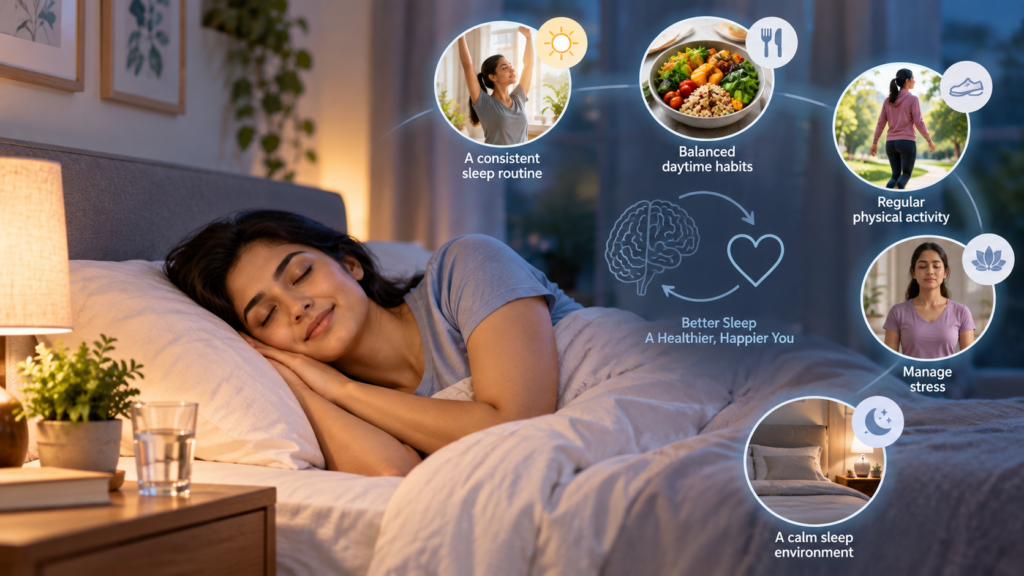
Sleep is a beautiful example of why health cannot be reduced to one isolated behaviour.
Consider the chain:
Food → energy → activity → mood → stress → sleep
But it can also run in the opposite direction:
Sleep → appetite → energy → activity → mood → stress → digestion
The relationships are dynamic.
This is why I prefer to look at the whole pattern of life rather than searching for one cause or one solution.
Sleep is influenced by biology.
But it is also influenced by lifestyle, environment, emotions, work, relationships, health conditions and daily routine.
A genuinely holistic approach recognises all of these while still respecting the need for appropriate medical diagnosis and treatment.
Five Principles I Encourage
If you remember only five things from this article, remember these:
Key Takeaways
- Sleep is a biological necessity, not a luxury. Your body and brain need adequate sleep to function well.
- Stress and sleep influence each other. Managing one may help the other, although persistent problems need appropriate assessment.
- Consistency matters. A reasonably stable daily rhythm can be more useful than constantly changing sleep strategies.
- Relaxation can support sleep, but it is not a cure-all. Breathing, meditation and yoga can be useful components of a healthy routine.
- Persistent sleep problems deserve attention. Especially when accompanied by excessive daytime sleepiness, breathing difficulties during sleep or significant impairment in daily life.
Frequently Asked Questions
How many hours should an adult sleep?
Many adults function best with approximately 7–9 hours of sleep per night, although individual requirements vary. Sleep quality, regularity and daytime functioning are also important.
Why do I feel anxious at night?
Nighttime reduces external distractions, which can make thoughts and worries more noticeable. Stress and anxiety can also increase physiological arousal and make it harder to fall asleep.
Can stress cause insomnia?
Stress can contribute to difficulty falling asleep or staying asleep. If sleep difficulties become persistent, however, it is important to consider other contributing factors and seek appropriate assessment.
Does using a phone before bed affect sleep?
Screen use can contribute to sleep difficulties through light exposure, mental stimulation and delayed bedtime. The effect varies between individuals. Reducing stimulating phone use before bed is a reasonable experiment if sleep is problematic.
Can yoga improve sleep?
Yoga can include movement, breathing, relaxation and meditation practices that may support overall wellbeing and relaxation. It should complement, rather than replace, appropriate assessment and treatment for persistent sleep disorders.
Can meditation stop racing thoughts?
Meditation is not about stopping thoughts. It can help develop the ability to notice thoughts without automatically engaging with them. For some people, this can support relaxation and mental wellbeing.
Is daytime napping bad?
Not necessarily. A short nap can be useful for some people, while long or late naps may interfere with nighttime sleep. If you regularly need substantial daytime sleep because of excessive sleepiness, consider discussing this with a healthcare professional.
What if I sleep enough but still feel tired?
Persistent daytime fatigue despite apparently adequate sleep can have several causes, including poor sleep quality, sleep disorders, medical conditions, medications and lifestyle factors. If it continues, medical evaluation may be appropriate.
Is snoring a sign of poor sleep?
Occasional snoring is common. Loud habitual snoring, particularly with gasping, choking or pauses in breathing, may indicate sleep apnoea and should be medically assessed.
Final Thoughts: Sleep Is Part of Healthcare
We often think of health as something we actively do:
Exercise. Eat well. Take medicines. Attend appointments. Perform health checks.
But sometimes one of the most important things we can do is something that appears completely passive:
Sleep.
Sleep gives the brain and body an opportunity to perform essential biological functions.
It supports our ability to think, regulate emotions, move through the day and respond to life’s challenges.
It also reminds us that health is not simply about productivity.
We are not machines designed to work continuously.
Rest is not weakness.
Rest is part of physiology.
My approach is therefore not to encourage people to become obsessed with sleep optimisation. It is to help them develop a healthy relationship with sleep, one based on regularity, awareness, realistic habits and appropriate medical care when necessary.
If your sleep is occasionally disturbed, be kind to yourself.
If it is persistently poor, pay attention.
And if there are signs of a sleep disorder, do not simply try to meditate your way through it.
Understand the signal. Support the body. Respect the mind. And seek the right help when you need it.
Better health is not built only during the hours when we are awake.
Sometimes, an important part of healing begins when we allow ourselves to rest.
Related Reading
Visit the Yoga & Mind-Body topic page for the full range of mind-body content on this site.
The following related articles are part of the approved content corpus; several are not yet migrated to WordPress and are listed here as plain text rather than linked, per the project’s no-fabricated-link rule.
- DG-005 — Understanding the Gut–Brain Connection: How Stress, Emotions and Digestion Interact
- DG-011 — Food and Digestive Health: How Eating Habits Influence Digestion
- DG-012 — How Stress Affects Digestion: Understanding the Gut–Brain Response
- MB-001 — Stress and Anxiety: Understanding the Mind–Body Connection and Supporting Better Health
- MB-003 — Relaxation Techniques for Stress: Breathing, Body Awareness and Mindfulness
- MB-008 — Breathing Patterns & States of Mind: Understanding the Connection Between Breath, Body and Mind
- YG-001 — Yoga for Health: A Practical Guide to Movement, Breath, Mind and Whole-Person Wellbeing
- YG-002 — Yoga for Stress Management: Practices for Relaxation, Awareness and Better Wellbeing
- Holistic Health: A Practical Guide to Whole-Person Wellbeing
- HH-002 — Integrative Medicine and Holistic Health: Bringing the Whole Person Into Healthcare
Medical Disclaimer
This article is intended for general educational purposes and does not constitute individual medical advice, diagnosis or treatment. Sleep requirements and sleep problems vary between individuals. Persistent insomnia, excessive daytime sleepiness, loud habitual snoring, witnessed pauses in breathing, gasping during sleep or other concerning symptoms should be discussed with a qualified healthcare professional. Do not discontinue prescribed medication or delay necessary medical care based on information presented in this article.