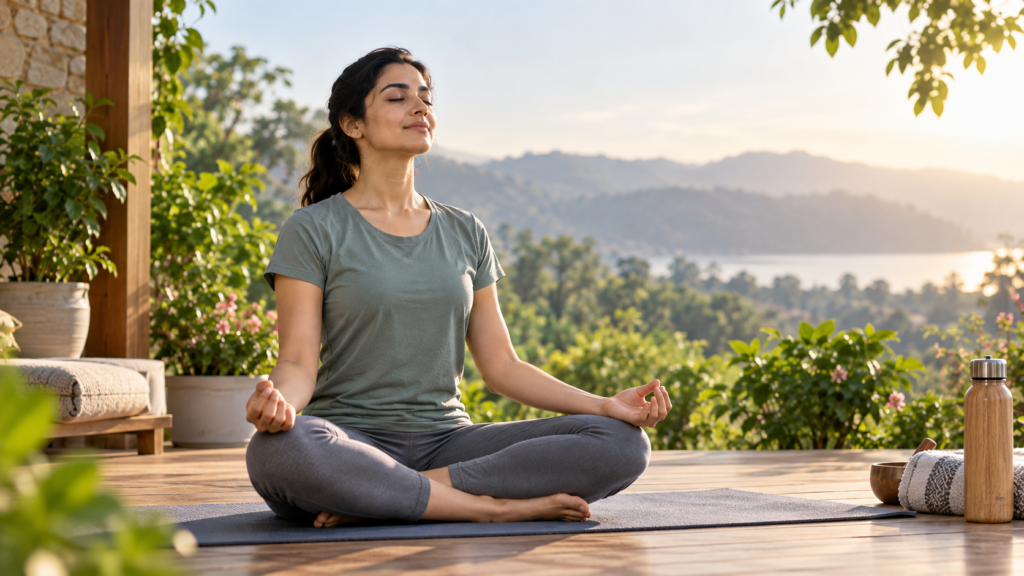
A practical guide to using gentle movement, breathing, relaxation and mindful awareness to support a calmer, more balanced life
Stress is a normal part of life. Work, relationships, financial pressures, health concerns, uncertainty and constant demands can all place the mind and body under strain.
A certain amount of stress can help us respond to challenges. The difficulty begins when stress becomes frequent, intense or prolonged, leaving little opportunity for the body and mind to recover.
This is where yoga can have an important supportive role.
Yoga is more than a collection of physical postures. Traditionally, it encompasses movement, breathing practices, concentration, meditation, relaxation and ways of cultivating greater awareness. When practised appropriately, these components can become practical tools for regulating daily stress and developing a healthier relationship with the body and mind.
In my clinical and academic journey with yoga and mind–body health, I have found that one of the most useful aspects of yoga is its emphasis on awareness. The objective is not simply to make the body more flexible. It is to learn to notice breathing, muscular tension, thoughts, emotions and patterns of reactivity—and gradually respond to them with greater steadiness.
This article explains how yoga may support stress management and how you can begin with a simple, gentle practice.
Important: Yoga can support wellbeing and may complement appropriate medical or psychological care, but it should not be considered a cure for anxiety, depression, chronic disease or other medical conditions. Persistent or severe symptoms deserve professional evaluation.
What Is Stress?
Stress is the body’s response to a perceived challenge, demand or threat.
When we encounter a stressful situation, the body can activate systems that increase alertness and prepare us to respond. Heart rate may rise, breathing can become faster, muscles may tense, and attention becomes focused on the immediate situation.
This response is useful when action is required.
The problem is that modern stressors often do not have a clear beginning and end.
A demanding workday may be followed by emails at night. Financial concerns can continue in the background. Relationship difficulties may occupy the mind even when the body is physically safe.
As a result, some people find it difficult to shift from a state of activation into genuine recovery.
Common signs of ongoing stress may include:
- Feeling constantly rushed or overwhelmed
- Irritability or emotional reactivity
- Difficulty relaxing
- Muscle tension, particularly around the neck and shoulders
- Headaches
- Changes in sleep
- Fatigue
- Difficulty concentrating
- Changes in appetite
- Digestive discomfort
- Restlessness
- Repetitive worrying
These symptoms are not specific to stress, however. Other physical and mental health conditions can produce similar experiences.
How Can Yoga Help With Stress Management?
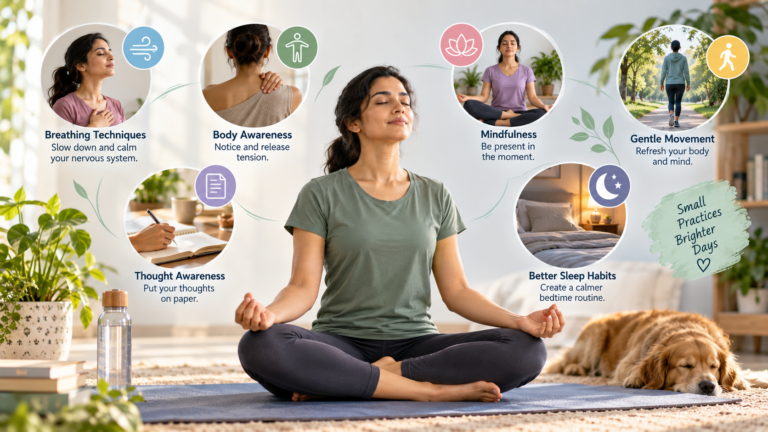
Yoga brings together several practices that may influence different aspects of the stress experience.
1. Movement
Gentle physical movement can help people become more aware of muscular tension, posture and bodily sensations.
Rather than treating exercise as another performance goal, yoga encourages attention to how the body feels during movement.
This distinction matters.
A stressful person may already be operating in a highly goal-oriented mode. Turning yoga into another activity that must be performed perfectly can defeat some of its purpose.
A slower, comfortable practice can instead create an opportunity to pause.
2. Breathing Awareness
Stress can influence breathing patterns. Some people notice that their breathing becomes faster, shallower or more irregular when they are tense.
Yoga traditionally places considerable importance on conscious breathing.
A simple practice is to observe the breath without trying to control it aggressively.
Notice:
- Where you feel the breath
- Whether the inhalation and exhalation feel comfortable
- Whether the shoulders are unnecessarily tense
- Whether the breath is smooth or interrupted
With practice, gentle breathing awareness can become a way of recognising early signs of tension.
A simple extended-exhalation practice
Sit or lie comfortably.
Allow the breath to remain natural for several cycles.
Then, without forcing the inhalation, allow the exhalation to become slightly longer and smoother than the inhalation.
For example:
Inhale gently → exhale slowly → pause naturally → repeat
There is no need to hold the breath.
If you feel dizzy, uncomfortable, breathless or anxious, stop and return to normal breathing.
3. Relaxation
One of the most valuable skills in stress management is learning how to deliberately relax.
Yoga includes several traditional relaxation approaches, including conscious relaxation and practices that direct attention through different parts of the body.
A simple body-awareness exercise can be done lying down or sitting comfortably.
Bring attention gradually to:
- Feet
- Legs
- Abdomen
- Chest
- Hands
- Arms
- Shoulders
- Neck
- Face
- Whole body
At each area, simply notice whether there is tension.
You do not have to force the muscles to relax.
Often, awareness itself is the first step.
4. Mindfulness and Attention
Stress is not only a physical experience.
The mind may repeatedly revisit past events or anticipate future problems.
Yoga and meditation practices encourage attention to what is happening in the present moment.
This does not mean eliminating thoughts.
Instead, you learn to notice thoughts without automatically following every thought.
For example:
“I am having a worrying thought.”
is different from:
“This thought must be true.”
That small shift can create psychological space.
5. Developing Self-Awareness
Yoga can also teach us to recognise patterns.
Perhaps you hold your breath whenever you become anxious.
Perhaps your shoulders rise when you concentrate.
Perhaps you clench your jaw while working.
Perhaps you continue working even when your body is clearly asking for rest.
The practice of yoga creates repeated opportunities to notice these patterns.
This awareness can eventually extend beyond the yoga mat and into everyday life.
Yoga Is More Than Physical Postures
The physical postures, or asana, are only one component of yoga.
Depending on the tradition and style of practice, yoga may involve:
- Asana — physical postures
- Pranayama — traditional breathing practices
- Dharana — concentration
- Dhyana — meditation
- Relaxation practices
- Self-observation
- Ethical and lifestyle principles
For stress management, it can therefore be helpful to think beyond flexibility and fitness.
A short practice containing gentle movement, comfortable breathing and relaxation may be more relevant to stress than an intense sequence of physically demanding postures.
A Gentle Yoga Sequence for Stress
The following sequence is designed as a general wellbeing practice rather than treatment for a specific medical condition.
Move slowly and stay within a comfortable range.
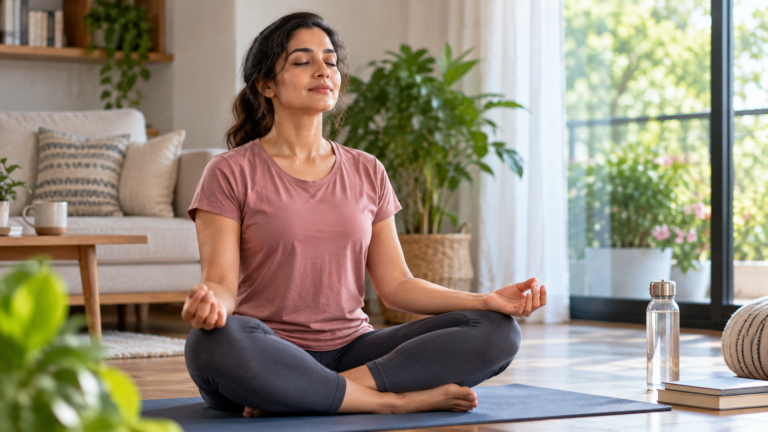
1. Comfortable Sitting
Sit on a chair, cushion or mat.
Let the spine be comfortably upright without becoming rigid.
Close the eyes if that feels comfortable.
Take several natural breaths.
Spend about one minute simply noticing the body and breath.
2. Gentle Neck and Shoulder Movements
Slowly move the shoulders upward and then allow them to soften.
Repeat several times.
Then make small, comfortable neck movements.
Avoid forcing the neck into extreme positions.
The objective is awareness and gentle mobility—not stretching as far as possible.
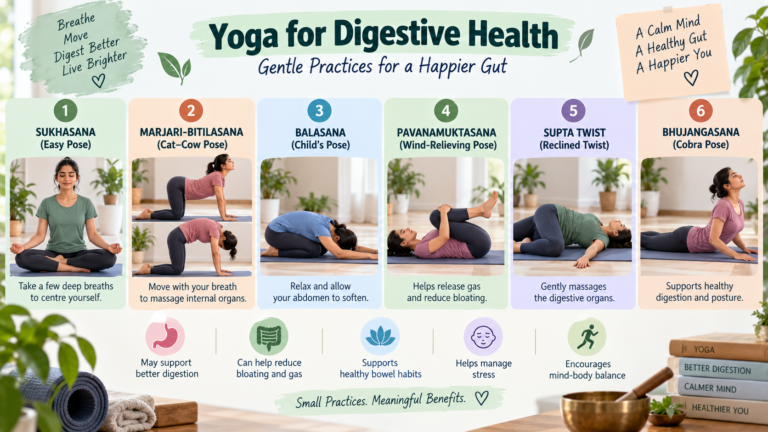
3. Cat–Cow Movement
Come onto hands and knees if comfortable.
As you inhale, gently move toward a lengthened spine.
As you exhale, gently round the back.
Move slowly with the breath.
Repeat approximately 5–8 cycles.
If getting onto the floor is uncomfortable, a similar movement can be performed while seated.
4. Child’s Pose
From a kneeling position, gently lower the body toward a comfortable resting position.
You may place a cushion or bolster under the chest or head for support.
Stay for several breaths.
If this position causes knee, hip, back or breathing discomfort, choose another resting posture.
5. Gentle Seated Forward Movement
Sit comfortably with the legs in a position that does not strain you.
Keeping the movement gentle, lean forward slightly.
There is no need to reach toward the feet.
The emphasis is on releasing effort and noticing the breath.
Avoid this posture if it aggravates existing pain or if your healthcare professional has advised against it.
6. Gentle Seated Twist
Sit upright.
Place one hand comfortably beside or behind you and gently rotate the torso.
Do not force the rotation.
Return to centre and repeat on the other side.
Keep the movement within a pain-free range.
7. Supported Resting Pose
Lie comfortably on your back or choose another supported position.
Allow the arms and legs to rest naturally.
Place a cushion beneath the knees if that makes the lower back more comfortable.
Stay here for 2–3 minutes.
Let the breathing return to its natural rhythm.
8. Final Relaxation
Allow the body to become still.
Bring attention to:
- The contact of the body with the surface beneath you
- The movement of the breath
- The muscles of the face
- The shoulders
- The abdomen
- The hands and feet
There is nothing to accomplish.
Simply rest and observe.
Even a few minutes of conscious relaxation can be a valuable transition between activity and recovery.
A Simple 10-Minute Yoga Practice for Stress
If you have very little time, try this:
| Practice | Approximate time |
|---|---|
| Quiet sitting and breath awareness | 1 minute |
| Shoulder and neck movements | 1 minute |
| Cat–cow or seated spinal movement | 2 minutes |
| Gentle resting posture | 2 minutes |
| Comfortable breathing | 2 minutes |
| Final relaxation | 2 minutes |
The exact duration is not important.
Consistency is generally more useful than intensity.
A 10-minute practice that you can comfortably repeat several times a week may be more sustainable than an ambitious routine that you abandon after a few days.
Yoga Breathing for Stress: Keep It Gentle
Breathing practices deserve special care.
Not every pranayama technique is appropriate for every person or every situation.
Some traditional practices involve rapid breathing, forceful breathing or breath retention. These should not automatically be treated as relaxation techniques.
For a beginner who is already stressed, a safer starting point is usually:
Awareness → comfort → smoothness → gradual practice
Rather than:
Force → intensity → longer breath retention → performance
If breathing practice causes dizziness, chest discomfort, significant breathlessness, panic or unusual symptoms, stop and seek appropriate guidance.
Yoga and Sleep
Stress and sleep can influence each other.
Poor sleep can make everyday stress more difficult to manage, while ongoing stress can make it harder to settle at night.
A calming evening practice may help create a transition between daytime activity and bedtime.
An evening routine could include:
- Gentle stretching
- Comfortable breathing
- Body awareness
- A short meditation
- Yoga nidra or guided relaxation
- Reduced stimulation before bed
Yoga should not be considered a substitute for evaluation when insomnia is persistent, severe or associated with another medical or mental-health condition.
Yoga, Stress and Digestive Health
The relationship between stress and digestion is another reason relaxation practices can be useful.
The digestive system communicates continuously with the nervous system. Stress can influence appetite, bowel habits and the perception of digestive discomfort.
This does not mean that yoga can treat every digestive disorder.
Instead, yoga may form one part of a broader approach that includes:
- Appropriate medical evaluation
- Nutritious food
- Regular meals
- Physical activity
- Adequate sleep
- Stress management
- Hydration
- Appropriate treatment when needed
This whole-person approach is particularly important when digestive symptoms are persistent.
Yoga and Anxiety: An Important Distinction
Yoga is often discussed in relation to anxiety, but careful language matters.
Yoga practices may support relaxation, body awareness and emotional regulation. Some people find them useful as part of managing stress and anxiety symptoms.
However, yoga should not be presented as a replacement for evidence-based mental-health care.
If anxiety is persistent, severe or interfering significantly with work, relationships, sleep or daily functioning, professional assessment is appropriate.
Seek urgent help if you experience thoughts of self-harm, feel unable to keep yourself safe, or are experiencing a mental-health crisis.
An Ayurvedic and Yogic Perspective on Stress
Traditional Indian health systems have long considered wellbeing in relation to lifestyle, behaviour, mental state, environment and daily routine.
Ayurvedic and yogic traditions use concepts and frameworks that differ from modern biomedical physiology.
For example, traditional yoga places considerable emphasis on the relationship between attention, breath, behaviour and mental steadiness. Ayurveda similarly gives importance to daily routine, food, sleep, activity and individual constitution.
These are traditional frameworks, not direct equivalents of modern physiological mechanisms.
They can provide useful perspectives for self-observation and healthy living while remaining distinct from evidence-based medical diagnosis and treatment.
How Long Should You Practise Yoga for Stress?
There is no single ideal duration.
You might begin with:
5 minutes. Useful on particularly busy days.
10 minutes. A practical starting point for regular practice.
15–20 minutes. Allows more time for movement, breathing and relaxation.
30 minutes or more. May suit people who already have an established practice.
The important question is not:
“How long can I practise?”
It is:
“What practice can I realistically sustain?”
A 7-Day Yoga for Stress Starter Plan
You do not need to change everything at once.
Day 1 — Awareness. Spend 5 minutes observing your breathing.
Day 2 — Movement. Practise 5–10 minutes of gentle mobility.
Day 3 — Breath. Practise comfortable breathing with a slightly longer exhalation.
Day 4 — Relaxation. Do a 10-minute body-awareness or relaxation practice.
Day 5 — Gentle Yoga. Combine movement and breathing for 10–15 minutes.
Day 6 — Mindful Practice. Perform your usual sequence while paying attention to bodily sensations and breath.
Day 7 — Personal Routine. Choose the practices that felt comfortable and useful and create your own short routine.
The goal is not to complete seven perfect days.
The goal is to discover what you can continue.
A 15-Minute Whole-Person Stress Routine
Once you are comfortable with the basics, you can combine the elements:
2 minutes — Settling. Sit quietly and notice the breath.
5 minutes — Gentle movement. Use comfortable spinal, shoulder and hip movements.
3 minutes — Breathing. Allow the breath to become smooth and comfortable.
3 minutes — Relaxation. Lie down or sit in a supported position.
2 minutes — Quiet awareness. Notice how the body and mind feel without judging the experience.
This structure is deliberately simple.
A stress-management practice does not have to become another complicated project.
Common Mistakes When Using Yoga for Stress
Trying to make every posture perfect
Stress management is not a flexibility competition. Comfort and awareness matter more than achieving a particular shape.
Practising too intensely
A physically demanding session may not be the right choice when you are exhausted, unwell or highly activated.
Forcing the breath
Breathing should remain comfortable. More intense does not necessarily mean more beneficial.
Holding uncomfortable positions
Pain is not a requirement for progress. Modify or stop when something feels wrong.
Expecting immediate transformation
Yoga is a practice. Its value often comes from repeated exposure to movement, awareness, breathing and relaxation rather than from one dramatic session.
Using yoga instead of necessary healthcare
This is one of the most important boundaries. Yoga can complement healthcare. It should not delay appropriate medical or psychological evaluation.
Who Should Modify Their Yoga Practice?
Most yoga practices can be adapted, but individual circumstances matter.
Extra care may be appropriate if you have:
- A recent injury
- Significant joint or spinal problems
- Severe pain
- Balance difficulties
- Cardiovascular or respiratory conditions
- Pregnancy
- Recent surgery
- Neurological conditions
- Uncontrolled medical conditions
- Frequent dizziness or fainting
If you have a medical condition or are unsure whether a particular practice is appropriate, consult your healthcare professional or a suitably qualified yoga professional.
When Stress Needs More Than Yoga
Yoga can be one part of stress management, but it cannot address every cause of distress.
Consider seeking professional help if stress is:
- Persistent and difficult to control
- Seriously affecting sleep
- Interfering with work or relationships
- Associated with significant anxiety or depression
- Causing substantial changes in appetite or functioning
- Accompanied by recurrent panic symptoms
- Associated with substance misuse
- Producing physical symptoms that are new, severe or unexplained
And remember that symptoms such as chest pain, severe breathing difficulty, fainting, sudden neurological symptoms or other acute changes require appropriate medical assessment rather than self-treatment with yoga. If any of this applies to you, arranging a consultation is a reasonable next step.
Building a Sustainable Yoga Habit
The most useful yoga routine is one that fits into your life.
Try attaching your practice to an existing habit.
For example:
After waking → 5 minutes of movement
Before lunch → 2 minutes of conscious breathing
After work → 10 minutes of gentle yoga
Before bed → 5 minutes of relaxation
You do not have to practise for an hour every day.
You can create several small opportunities for awareness throughout the day.
Over time, these pauses may become part of your lifestyle rather than another task on your schedule.
Five Principles I Encourage for Stress-Management Yoga
If I had to simplify the approach, I would keep these five principles in mind:
1. Be regular rather than extreme. A manageable practice repeated consistently is valuable.
2. Let comfort guide intensity. Yoga should not require unnecessary strain.
3. Include the breath. Movement and breathing can be practised together.
4. Give the mind a role. Awareness is central to yoga—not an optional extra.
5. Know the limits of yoga. Use it as supportive care, while seeking appropriate medical or psychological treatment when needed.
Frequently Asked Questions
Is yoga good for stress?
Yoga may help support stress management through gentle movement, breathing, relaxation and mindful awareness. It is best viewed as one component of a broader approach to wellbeing rather than a cure for stress-related or mental-health conditions.
How often should I practise yoga for stress?
A practical starting point is a short, comfortable practice several times a week. Even 5–10 minutes can be a useful beginning if it helps you establish consistency.
Which yoga is best for stress?
There is no single style that is universally best. For someone seeking relaxation, gentle movement, comfortable breathing, restorative practices and relaxation may be more appropriate than highly demanding physical practice.
Can yoga reduce anxiety?
Yoga may support relaxation and emotional wellbeing, and some people find it helpful alongside other approaches. Persistent or significant anxiety should be assessed by an appropriate healthcare or mental-health professional.
Can I practise yoga if I am a beginner?
Yes. Begin with simple movements and comfortable breathing. You do not need flexibility or previous experience to start.
Should I practise yoga when I am very stressed?
Gentle practice may be appropriate, but listen to your body. If you are dizzy, acutely unwell, in significant pain or experiencing severe psychological distress, seek appropriate care rather than attempting to manage the situation through yoga alone.
Can yoga help with sleep?
A calming evening practice may support relaxation and create a useful bedtime routine. Persistent insomnia, however, may have multiple causes and may require professional evaluation.
Is yoga the same as meditation?
No. Yoga is a broader traditional system that can include physical postures, breathing, concentration, meditation, relaxation and other practices. Meditation is one component within some yoga traditions.
Final Thoughts
Stress management is not about eliminating every stressful event from life.
That is rarely possible.
The deeper goal is to develop healthier ways of responding to the demands of life while also addressing the circumstances that create unnecessary stress.
Yoga can offer a practical space for that process.
A few minutes of movement can reconnect you with the body.
A few conscious breaths can create a pause.
A period of relaxation can remind the body that it does not need to remain constantly prepared for action.
And a few moments of awareness can help you notice what is happening before automatically reacting to it.
This is one reason I see yoga not merely as exercise, but as a practical mind–body discipline.
Its greatest value may not be in performing increasingly difficult postures.
It may be in learning to become more aware of yourself—and carrying that awareness into the way you eat, sleep, work, breathe, move, relate and live.
Start gently. Practise regularly. Observe honestly. Adapt intelligently. And use yoga as one part of a broader, balanced approach to health.
Related Reading
Visit the Yoga & Mind-Body topic page for the full range of yoga and mind-body content on this site.
If you would like to explore this subject further, these articles form a natural progression:
The following related articles are part of the approved content corpus; several are not yet migrated to WordPress and are listed here as plain text rather than linked, per the project’s no-fabricated-link rule.
- Yoga for Health: A Practical Guide to Movement, Breath, Mind and Whole-Person Wellbeing
- Stress and Anxiety: Understanding the Mind–Body Connection and Supporting Better Health
- Relaxation Techniques for Stress: Breathing, Body Awareness and Mindfulness
- Breathing Patterns & States of Mind: Understanding the Connection Between Breath, Body and Mind
- Sleep and Mental Wellbeing: Understanding the Mind–Body Connection
- Understanding the Gut–Brain Connection: How Stress, Emotions and Digestion Interact
- How Stress Affects Digestion: Understanding the Gut–Brain Response
- Recommended Yoga Practices for Digestive Health: A Gentle, Practical Guide
- Ayurvedic Diet: Traditional Principles for Everyday Health and Whole-Person Wellbeing
- Holistic Health: A Practical Guide to Whole-Person Wellbeing
Medical Disclaimer
This article is intended for general educational and wellbeing purposes. It is not a substitute for individual medical diagnosis, treatment or professional advice.
Yoga, breathing exercises, meditation and relaxation practices may support general wellbeing and may complement appropriate healthcare, but they should not be presented as replacements for necessary medical or mental-health evaluation and treatment.
Practise within your own physical limits. If you have a medical condition, significant symptoms, an injury, are pregnant, or are uncertain whether a particular practice is appropriate for you, seek advice from a suitably qualified healthcare professional.