Introduction
You are breathing right now. You probably were not consciously thinking about it. That is one of the remarkable features of breathing: it happens automatically, yet it is also something we can consciously influence.
When you are frightened, your breathing may become faster. When you are excited, your breathing may change. When you are physically active, you naturally breathe more deeply and rapidly. When you are relaxed, your breathing often becomes quieter and more comfortable.
The relationship works in both directions. Our mental and physical states can influence breathing, while consciously paying attention to breathing can influence our experience of tension, alertness, and relaxation. This is one reason breathing has an important place in mind–body health, yoga, meditation, and stress management.
But breathing exercises should not be presented as a cure for every health problem. Breathlessness, chest discomfort, dizziness, abnormal breathing, or sudden changes in breathing can be signs of medical problems and may require assessment.
The purpose of this article is to develop a practical understanding of breathing, how patterns change, why the breath matters, how breathing relates to states of mind, and how to approach simple breathing practices safely.
Breathing Is Both Automatic and Voluntary
One of the most interesting characteristics of breathing is that it sits between conscious and automatic control. You can decide to breathe more slowly, take a deeper breath, hold your breath briefly, or change the rhythm of your breathing. But you do not have to consciously remember to breathe every moment, the nervous system continuously regulates breathing according to the body’s needs.
For example, during exercise, the demand for oxygen and the production of carbon dioxide change, and breathing responds accordingly. During sleep, breathing continues without conscious control. This dual nature makes breathing particularly interesting in mind–body practices: we can observe an automatic process and, within limits, influence it consciously.
Why Does Breathing Change With Emotion?
Think about how you breathe when you are frightened, angry, excited, relaxed, sleepy, concentrating, or exercising. The pattern is rarely identical. Emotions are associated with changes in the autonomic nervous system, muscle activity, attention, and arousal, and breathing is part of this broader physiological response.
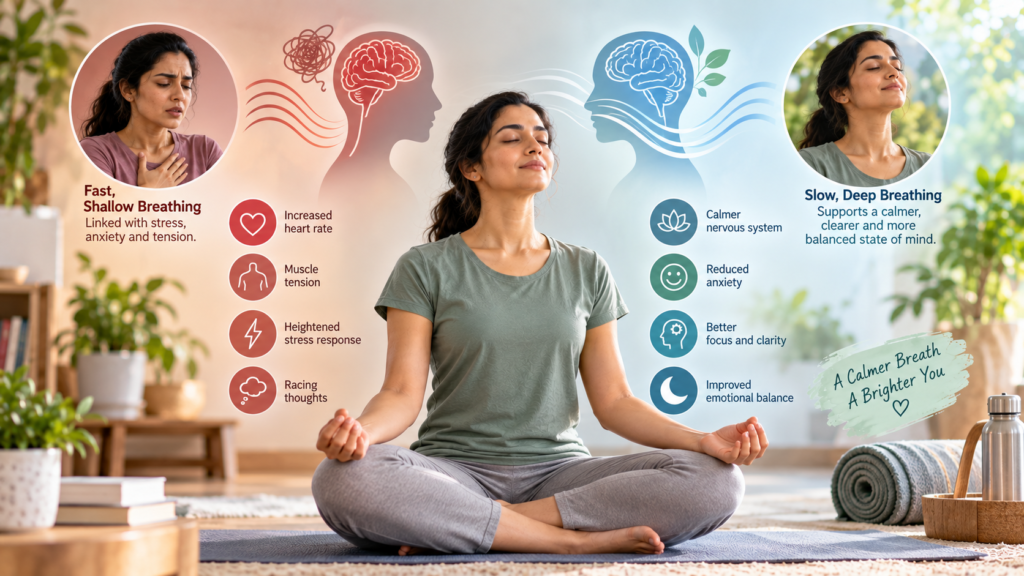
For example, someone who feels threatened may begin breathing faster and more shallowly. Someone who is deeply relaxed may breathe more slowly and comfortably. This does not mean that there is one breathing pattern corresponding perfectly to every emotion, human physiology is more complicated than that. But the connection is real enough that breathing awareness has become an important component of many approaches to relaxation and mind–body practice.
The Autonomic Nervous System and Breathing
The autonomic nervous system helps regulate many functions that occur without conscious effort. It includes sympathetic and parasympathetic components that participate in regulating processes such as heart rate, blood pressure, digestion, sweating, pupil responses, and breathing-related functions.
The sympathetic system is often associated with mobilising the body for action. The parasympathetic system contributes to restoration and recovery. It is important not to oversimplify this into “sympathetic = bad, parasympathetic = good.” Both are necessary. If you are running to catch a bus, increased sympathetic activation is appropriate. If you are sitting quietly after dinner, a calmer state may be more appropriate. Health involves the ability to adapt.
What Is a Breathing Pattern?
A breathing pattern includes several features:
- Rate, how many breaths you take over a period of time.
- Depth, how much air moves with each breath.
- Rhythm, whether breathing is regular or irregular.
- Location of movement, you may notice movement predominantly in the chest, abdomen, or both.
- Effort, breathing may be effortless, or may involve noticeable muscular effort.
- Mouth vs nose, people may breathe through the nose, mouth, or both depending on circumstances.
- Pauses, breathing can naturally include brief transitions between inhalation and exhalation.
These features can change according to activity, health, environment, emotion, sleep, and attention.
What Happens When We Are Stressed?
Stress can change breathing. A person under pressure may unconsciously begin to breathe more quickly, breathe more shallowly, hold the breath intermittently, sigh frequently, tighten the chest or abdominal muscles, breathe through the mouth, or become highly aware of every breath.
This can create a feedback loop: stress → altered breathing → unusual bodily sensations → increased attention → more worry → further stress. This does not happen to everyone, and it is not the explanation for every breathing complaint. But when stress is contributing to a person’s breathing pattern, awareness and appropriate breathing practice may help interrupt the cycle.
Hyperventilation and Overbreathing
One important concept is hyperventilation, breathing more than the body’s metabolic requirements. This can reduce carbon dioxide levels in the blood and produce symptoms such as light-headedness, tingling, dizziness, chest tightness, a feeling of not getting enough air, difficulty concentrating, or a sense of unreality.
These sensations can themselves be frightening. A person may respond by trying to take even larger breaths, which can sometimes make the cycle worse. This is one reason that “take a huge deep breath” is not always appropriate advice. For many people, especially during anxiety-related overbreathing, the goal is not bigger breathing, it may be quieter, slower, more comfortable breathing.
Persistent or unexplained breathing symptoms should be medically assessed rather than assumed to be anxiety.
The Difference Between Comfortable Deep Breathing and Forceful Breathing
“Deep breathing” is commonly recommended for stress, but deeper is not automatically better. A comfortable breath allows the body to breathe without unnecessary strain. Forceful breathing may involve exaggerated inhalations, repeated large breaths, excessive chest movement, breath-holding, rapid breathing, or deliberate overbreathing. These techniques are not appropriate for everyone. A gentle breathing practice usually begins with comfort and awareness and gradual slowing, rather than maximum inhalation.
A Simple Breathing Awareness Practice
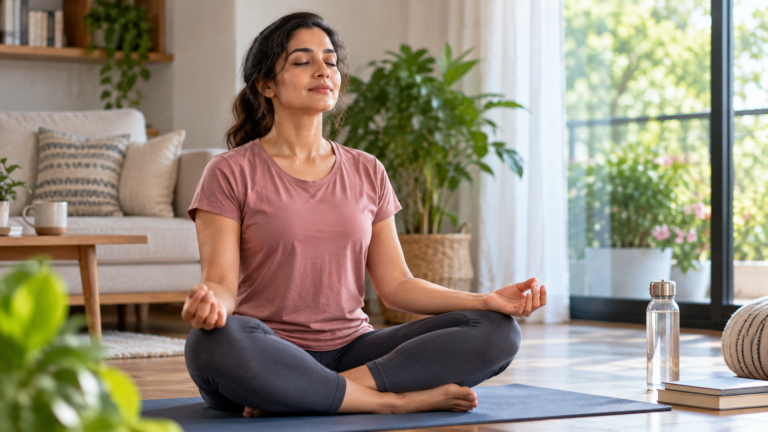
You do not need to immediately change your breathing. Start by observing it. Sit comfortably and allow your body to settle. Notice: is the breath fast or slow? Is it comfortable? Is there tension in the shoulders? Is the abdomen moving naturally? Are you breathing through the nose or mouth? Are you holding your breath without realising it?
Do not judge what you notice. Simply observe, for one to two minutes. This is already a breathing practice.
Comfortable Diaphragmatic Breathing
The diaphragm is an important muscle involved in breathing. When it contracts, it moves downward and contributes to expansion of the thoracic cavity. During relaxed breathing, movement can be felt around the lower ribs and abdomen.
A simple practice is to sit or lie comfortably and allow the abdomen and lower ribs to move naturally as you breathe. Do not push the abdomen outward deliberately. Do not force the breath. Try a gentle inhalation followed by a relaxed exhalation for a few minutes. The objective is comfort and awareness.
Should the Abdomen Always Move During Breathing?
No. Breathing is not identical in every posture or circumstance. The chest and abdomen both participate in normal breathing mechanics. During exercise, for example, breathing naturally becomes more active. The aim of breathing practice is not to create one rigid pattern that must be maintained throughout the day, instead, learn to recognise what is appropriate for this situation.
Breathing and the Vagus Nerve
The vagus nerve is an important component of the parasympathetic nervous system and contributes to communication between the brain and multiple organs, including the digestive system. It is often mentioned in discussions about breathing and relaxation.
However, explanations of the vagus nerve are sometimes exaggerated online. You may encounter claims that a particular breathing technique “activates the vagus nerve” and therefore cures a wide range of diseases. Such claims should be approached cautiously. Breathing influences autonomic physiology, but health is not controlled by a single nerve that can simply be “switched on.” The body is an interconnected system.
Breathing and Heart Rate
Breathing and heart rate are also connected. During normal breathing, heart rate can vary slightly with the respiratory cycle, sometimes referred to as respiratory sinus arrhythmia. This is a normal physiological phenomenon, particularly noticeable in younger and healthy individuals, and it illustrates the interaction between respiratory and cardiovascular regulation. Again, the lesson is not that one breathing pattern “controls the heart”, the lesson is that body systems continuously communicate and adapt to one another.
Breathing and the Gut–Brain Connection
Breathing is particularly relevant to digestive health because it provides one accessible way to work with the mind–body component of digestion. Stress may influence gut motility, abdominal sensations, appetite, bowel habits, bloating, nausea, and symptom perception.
Breathing exercises may help some people settle their nervous system, especially when symptoms are accompanied by tension or anxiety. But breathing should complement, not replace, appropriate digestive evaluation. (Source references a companion article, DG-005, Understanding the Gut–Brain Connection, also part of this pilot; see the corpus manifest for cross-link status.)
Breathing and Anxiety
When someone feels anxious, breathing can become part of the experience. A person may feel “I cannot get a satisfying breath,” which can lead to repeated attempts to take increasingly large breaths. For some people, this can contribute to overbreathing.
A gentler approach may be to stop trying to force the breath, relax unnecessary muscular tension, allow the breath to become quieter, make the exhalation comfortable, and observe rather than constantly monitor.
However, genuine breathlessness must never automatically be labelled anxiety. Breathlessness can have many causes, including respiratory, cardiovascular, metabolic, neurological, and other conditions. New or severe breathlessness warrants appropriate medical evaluation.
A Gentle 5-Minute Breathing Practice
Minute 1, Arrive. Sit comfortably. Allow the shoulders and jaw to relax. Notice the natural breath.
Minute 2, Observe. Notice the movement of the chest and abdomen. Do not change the rhythm yet.
Minute 3, Soften. Allow the breath to become slightly quieter if this happens naturally. Avoid forcing a deeper inhalation.
Minute 4, Exhale comfortably. Pay attention to the sensation of a relaxed exhalation. Do not strain or hold the breath.
Minute 5, Return to natural breathing. Stop deliberately controlling the breath. Notice how you feel.
If the practice produces dizziness, discomfort, anxiety, or breathlessness, stop and return to normal breathing.
Should You Count Your Breaths?
Counting can help some people focus, for example, gently counting 1…2…3…4… during an inhalation and then allowing a comfortable exhalation. But counting is not necessary. For someone who becomes anxious when monitoring bodily sensations, counting may actually increase attention and worry. In that situation, simply noticing the breath may be more appropriate. The practice should support you, not become another performance task.
What About Longer Exhalations?
Many relaxation practices emphasise an exhalation that is somewhat longer than the inhalation, for example, a gentle inhale followed by a comfortable, slightly longer exhale. Some people find this calming. There is no need to force a specific ratio: you do not need to breathe in for four seconds and out for eight seconds simply because someone online recommends it. Comfort matters more than numbers. If you feel air hunger, dizziness, or discomfort, return to natural breathing.
What Is Pranayama?
Pranayama is a traditional yogic discipline involving breath regulation. It includes a wide variety of practices, some gentle and contemplative, others involving deliberate changes in breathing rate, alternate-nostril techniques, breath retention, forceful breathing, structured ratios, and advanced practices.
These techniques should not all be treated as interchangeable. Traditional yoga has a rich and sophisticated approach to breathing, but the safety and suitability of an individual technique depend on the person and the practice. For beginners, a simple, comfortable breathing practice is usually a sensible starting point.
Alternate-Nostril Breathing
Nadi Shodhana and related alternate-nostril practices are widely used in yoga traditions. A simple form involves alternating the nostril through which breathing occurs. For many people, this can become a focused and calming practice. However, beginners should avoid turning it into a competition involving long breath retention or forceful inhalation. If you feel dizzy or uncomfortable, stop. If nasal obstruction makes the practice difficult, do not force it.
Kapalabhati
Kapalabhati is a traditional yogic breathing practice involving active, forceful exhalations. It is sometimes promoted online as a way to burn abdominal fat, detoxify the body, cure constipation, cure acidity, cleanse the lungs, or balance hormones. Such broad claims are not appropriate. Kapalabhati is a specific traditional practice, not a universal medical treatment. It may also be unsuitable for some people. Beginners should learn advanced breathing practices from appropriately trained teachers, particularly when medical conditions are present.
Bhastrika
Bhastrika is another traditional breathing practice involving more forceful respiratory movements. It can produce substantial physiological stimulation. It should not be automatically prescribed for stress, anxiety, digestive disease, or other medical conditions. People with relevant health conditions should seek appropriate professional guidance before practising forceful breathing techniques.
Who Should Be Cautious With Breathing Practices?
Breathing exercises are often described as universally safe. That is too broad. Extra care may be appropriate for people with:
- Significant heart disease
- Significant lung disease
- Uncontrolled blood pressure
- A history of fainting
- Panic symptoms triggered by breath awareness
- Neurological conditions
- Pregnancy, particularly with advanced practices
- Recent surgery
- Other medical conditions requiring exercise modification
Advanced breath retention and forceful breathing require particular caution. If you have a medical condition, discuss appropriate practices with your healthcare professional and, where relevant, a properly trained yoga teacher.
When Breathing Problems Need Medical Attention
This is an essential part of any article about breathing. Do not assume that breathing difficulty is simply stress. Seek urgent medical care for symptoms such as: severe or sudden breathlessness, severe or new chest pain, fainting or near-fainting, blue or grey lips or skin, severe confusion, sudden neurological symptoms, or rapidly worsening breathing difficulty.
Persistent or recurrent breathlessness also deserves appropriate medical assessment. Breathing exercises should never delay necessary medical care. If this applies to you, arranging a consultation is a reasonable next step.
Breathing and Sleep
Breathing practices are sometimes used as part of a bedtime routine. A few minutes of comfortable breathing may help some people transition into a quieter state. However, persistent problems such as loud habitual snoring, witnessed pauses in breathing, repeated nighttime gasping, or excessive daytime sleepiness may indicate a sleep-related breathing disorder and deserve medical assessment. Relaxation exercises are not a substitute for evaluating possible sleep apnoea or other medical conditions.
Breathing and Meditation
Breathing is often used as an anchor in meditation. You might simply notice inhalation and exhalation without trying to manipulate the breath. When the mind wanders, gently return attention to breathing. This teaches a valuable skill: notice, acknowledge, return. The objective is not to empty the mind, it is to develop a different relationship with attention.
Breathing and Yoga
In yoga, breath is often integrated with movement. For example, movement combined with breath and attention can create a practice that is simultaneously physical and contemplative. This is one reason yoga can be valuable within a broader mind–body approach. But yoga does not require complicated breathing techniques, a beginner may benefit greatly from simply learning to breathe comfortably, coordinate breath and movement, avoid unnecessary tension, notice when they are holding their breath, and finish with a period of relaxation. (Source references a companion article, YG-001, Yoga for Health, not yet migrated to WordPress; not linked, see the corpus manifest.)
Breathing and Emotional States
Breathing can provide a window into our current state:
- When anxious, the breath may feel fast, shallow, irregular, or effortful.
- When physically active, breathing becomes faster and deeper to meet metabolic demands.
- When relaxed, breathing may become slower and quieter.
- When concentrating, some people unconsciously hold their breath or reduce their breathing.
- When surprised, a person may suddenly inhale or briefly stop breathing.
These patterns are not diagnostic. They are observations. The purpose of awareness is not to label yourself, it is to recognise what is happening and respond appropriately.
The Breath as a Bridge Between Mind and Body
This may be the most useful way to understand breathing. The breath sits at the intersection of body and mind. It responds to physical demand. It responds to emotion. It can be consciously influenced. And it can become an object of attention.
This makes it a practical bridge between physiological health and psychological wellbeing. When used thoughtfully, breathing practice can become a simple daily reminder to pause, observe, and respond rather than constantly react.
A Whole-Person Breathing Framework
Instead of asking “which breathing technique is best?”, ask five questions:
- What is happening physically? Am I exercising, resting, unwell, dizzy, breathless, or in pain?
- What is happening emotionally? Am I calm, anxious, frightened, frustrated, or overwhelmed?
- What is happening behaviourally? Am I rushing, holding my breath, sitting for long periods, or consciously overbreathing?
- What practice is appropriate? Would simple awareness be enough, or is professional guidance appropriate?
- Do I need medical evaluation? Could this breathing problem be a symptom of something requiring assessment?
This approach is safer than prescribing one breathing exercise to everyone.
A Practical Daily Breathing Routine
Morning (2 minutes), sit quietly and notice your breathing before beginning the day.
During work (30–60 seconds), relax your shoulders and jaw, notice whether you are holding your breath, and allow the breath to return to a comfortable pattern.
Before meals, take a moment to sit down, slow your pace, and breathe comfortably. This can also encourage more mindful eating.
During stressful moments, pause, notice the breath, avoid forcing a huge inhalation, and allow several comfortable breaths before responding.
Evening (3–5 minutes), practise quiet breathing or meditation before beginning your bedtime routine.
A Simple “Breathe Before You React” Practice
When you notice stress building:
- STOP, pause what you are doing.
- BREATHE, allow several comfortable breaths.
- NOTICE, what is happening in your body and mind?
- CHOOSE, what is the most useful next action?
This does not eliminate stress. It creates a small space between the event and your response. That space can be valuable.
Common Breathing Myths
Myth 1: “Everyone should breathe deeply all the time.” Not necessarily, breathing should adapt to the body’s needs.
Myth 2: “More oxygen is always better.” The body carefully regulates oxygen and carbon dioxide; deliberately overbreathing is not automatically beneficial.
Myth 3: “If I feel breathless, I should take bigger and bigger breaths.” Not always, overbreathing can sometimes worsen dizziness and air hunger. New or unexplained breathlessness requires appropriate assessment.
Myth 4: “One breathing technique can cure anxiety.” No single technique should be considered a universal cure. Anxiety disorders may require psychological treatment, medication, lifestyle changes, or combinations of care.
Myth 5: “Breathing exercises are completely risk-free.” Most gentle practices are low-risk for many people, but advanced techniques involving forceful breathing or prolonged breath retention are not appropriate for everyone.
Myth 6: “You must breathe into the belly.” Normal breathing involves coordinated movement of the diaphragm, ribs, chest wall, and abdominal structures. There is no need to force a particular visual pattern.
How Breathing Fits Into Integrative Health
A whole-person approach to health does not require choosing between conventional medicine and lifestyle practices. Instead, consider the appropriate role of each:
- Modern medicine, useful for diagnosis, investigation, evidence-based treatment, medications, procedures, and managing acute and chronic disease.
- Yoga, can contribute movement, breathing practices, attention, relaxation, and physical awareness.
- Meditation, can contribute attention training, self-awareness, reflection, and relaxation.
- Lifestyle medicine, emphasises nutrition, physical activity, sleep, stress management, social connection, and behaviour change.
- Ayurveda and traditional practices, may offer culturally meaningful approaches to daily routine, food, lifestyle, and mind–body concepts.
Each should be used within its appropriate role.
Your Daily Breathing Check
- Is my breathing comfortable?
- Am I unconsciously holding my breath?
- Are my shoulders unnecessarily tense?
- Am I breathing rapidly because I am physically active, or because I am stressed?
- Am I trying to force my breathing?
- Would one minute of quiet observation help?
- Do I have symptoms that require medical evaluation rather than a breathing exercise?
These questions can turn breathing from an unconscious process into a practical awareness tool.
Frequently Asked Questions
Can breathing exercises reduce stress?
Gentle breathing practices may help some people relax and develop greater awareness of physiological arousal. They are one component of stress management rather than a universal solution.
Can breathing exercises help anxiety?
They may help some people manage physiological arousal and develop relaxation skills. However, persistent or severe anxiety may require professional mental-health care.
Is slow breathing always better?
Not necessarily. Breathing should match the body’s circumstances. During exercise, breathing naturally becomes faster. The aim during relaxation is usually comfortable breathing rather than forcing the slowest possible rate.
How long should I practise breathing exercises?
Beginners can start with a few minutes. Consistency is generally more practical than long sessions that are difficult to maintain.
Can breathing exercises help digestion?
Breathing practices may support relaxation and the gut–brain component of digestive wellbeing. They should not be regarded as a standalone treatment for gastrointestinal disease.
Can pranayama cure disease?
Pranayama is a traditional yogic practice with potential wellbeing applications, but it should not be presented as a universal cure for medical diseases. Medical conditions require appropriate diagnosis and treatment.
Is breath-holding good for health?
Some traditional and contemporary practices include breath retention. Its suitability depends on the specific technique and the individual. Prolonged or forceful breath retention should not be practised casually, particularly by people with relevant medical conditions.
What should I do if breathing exercises make me dizzy?
Stop the exercise and return to comfortable natural breathing. If dizziness is significant, recurrent, or unexplained, seek appropriate medical evaluation.
Final Takeaway
Breathing is ordinary, but it is also extraordinary. It connects automatic physiology with conscious awareness. It changes with exercise, emotion, attention, sleep, and stress. And because we can observe and gently influence it, breathing provides a practical bridge between the body and the mind.
You do not need an advanced technique to begin. Start with awareness. Sit comfortably. Notice your natural breathing. Relax unnecessary tension. Allow the breath to become comfortable. Then return to your day.
Key Takeaways
- Breathing sits between automatic and conscious control, and reflects our physical and emotional state.
- Stress and anxiety can alter breathing patterns, sometimes contributing to overbreathing.
- Gentle, comfortable breathing practices are a reasonable starting point for most people; forceful or advanced techniques are not appropriate for everyone.
- Over time, awareness practice can become part of a broader approach to health that includes movement, nutrition, sleep, stress regulation, relationships, mindfulness, yoga, and appropriate medical care.
- The goal is not to control every breath, but to become more aware of the relationship between breathing, body, mind, and behaviour.
Related Reading
Visit the Yoga & Mind-Body topic page for the full range of mind-body content on this site.
The following related articles are part of the approved content corpus. Several are not yet migrated to WordPress, so they are listed here as plain text rather than linked (per the project’s no-fabricated-link rule). See the P4-19 corpus manifest for their current status.
- MB-001, Stress and Anxiety: Understanding the Mind–Body Connection
- DG-001, Digestive Health
- DG-003, Daily Gut Routine
- DG-004, Understanding Bloating
- DG-005, Understanding the Gut–Brain Connection
- DG-009, When Digestive Symptoms Need Medical Evaluation
- DG-018, Recommended Yoga Practices for Digestive Health
- YG-001, Yoga for Health
- AY-001, Ayurvedic Diet
- PC-001, Panchakosha
- Holistic Health: A Practical Guide to Whole-Person Wellbeing
- HH-002, Integrative Medicine & Holistic Health
- AU-010, Dr. Sarang Patil’s Approach to Integrative Health
Medical Disclaimer
This article is intended for general educational and health-awareness purposes. It is not a substitute for individual medical diagnosis, treatment, or professional advice.
Breathing practices should be adapted to the individual’s health, age, physical condition, pregnancy status, and medical circumstances. Advanced breathing techniques, forceful breathing, and prolonged breath retention may not be appropriate for everyone.
New, severe, persistent, or unexplained breathing difficulty, chest pain, fainting, or other concerning symptoms should receive appropriate medical evaluation rather than being attributed to stress or managed solely with breathing exercises.