Introduction
Health is often described in terms of the physical body.
We talk about blood pressure, blood sugar, cholesterol, digestion, weight, fitness, sleep and disease.
These are important.
Modern medicine has developed remarkable ways to understand, diagnose and treat physical illness. Yet anyone who has worked closely with patients also recognizes that a person’s experience of health is rarely limited to laboratory values or physical symptoms.
Two people with the same diagnosis may experience their illness very differently.
One may struggle primarily with pain or physical limitations. Another may be overwhelmed by anxiety. Someone else may be struggling with sleep, relationships, work, purpose or uncertainty about the future.
This raises an important question:
Can we understand a person’s health more completely by looking at the whole person rather than only one dimension?
One traditional Indian framework that offers a way of contemplating this question is Panchakosha.
The word Pancha means five, while Kosha is commonly translated as sheath, layer or covering.
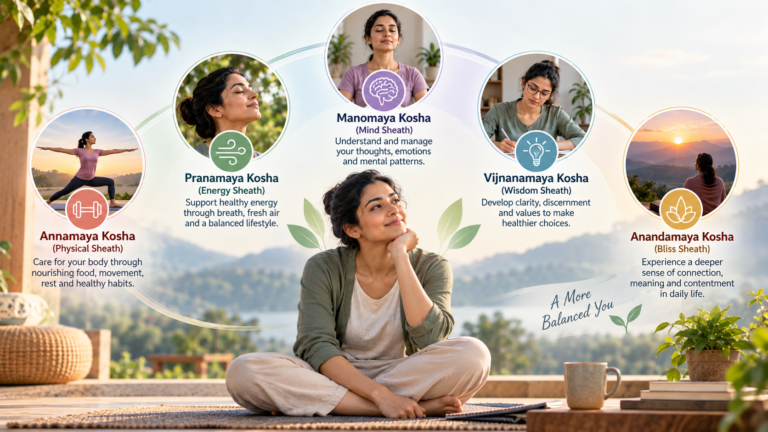
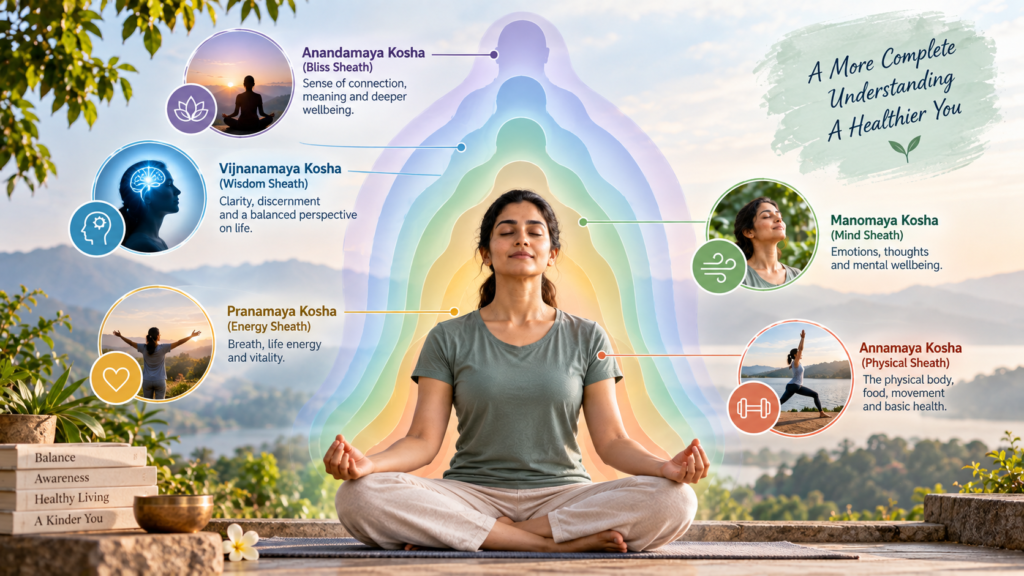
The Panchakosha model describes five interconnected dimensions of human existence:
- Annamaya Kosha — the physical or food-based dimension
- Pranamaya Kosha — the dimension associated with prana or vital energy
- Manomaya Kosha — the mental and emotional dimension
- Vijnanamaya Kosha — the dimension of discernment, understanding and wisdom
- Anandamaya Kosha — the dimension associated traditionally with deeper wellbeing or bliss
The framework comes from the Taittiriya Upanishad, within the broader Indian philosophical tradition.
It is important to understand Panchakosha in its proper context.
It is a traditional philosophical and contemplative framework, not a modern anatomical model and not a medical diagnostic system.
The five koshas should therefore not be presented as five scientifically established physical structures.
Instead, they can provide a useful way to reflect on the many dimensions through which people experience health, illness and wellbeing.
What Does Panchakosha Mean?
The traditional Panchakosha model can be imagined as a series of increasingly subtle layers of human experience.
The outermost dimension relates to the physical body.
Moving inward, the framework considers breath and vital processes, mind and emotions, discernment and understanding, and finally a deeper dimension associated with wellbeing and inner fulfilment.
A simplified representation, moving from the outermost to the innermost layer, is: Annamaya → Pranamaya → Manomaya → Vijnanamaya → Anandamaya.
This should not be interpreted as a literal physical structure.
It is better understood as a map for contemplation.
The model encourages us to ask:
- What is happening in my body?
- What is happening with my energy and breathing?
- What is happening in my mind?
- How am I interpreting and responding to my experience?
- What gives my life meaning, connection and deeper wellbeing?
These questions can complement — but never replace — appropriate medical assessment.
The Five Koshas
1. Annamaya Kosha — The Physical Dimension
Anna is commonly associated with food.
Annamaya Kosha therefore refers traditionally to the physical body — the dimension sustained by nourishment.
This is the most tangible aspect of health.
It includes everything we ordinarily associate with physical wellbeing:
- nutrition
- digestion
- movement
- strength
- flexibility
- sleep
- physical fitness
- body composition
- illness
- injury
- recovery
Modern medicine has enormous depth in this area.
We can investigate:
- blood tests
- imaging
- organ function
- cardiovascular health
- metabolic markers
- neurological function
- infectious disease
- structural abnormalities
When a person has physical symptoms, this dimension should never be dismissed in favour of a purely psychological or spiritual explanation.
For example, persistent abdominal pain deserves appropriate clinical assessment.
Chest pain deserves appropriate assessment.
Unexplained weight loss deserves investigation.
Persistent breathlessness deserves evaluation.
A whole-person approach begins with respecting the physical reality of the person.
Food and Annamaya Kosha
The traditional association between food and the physical body offers an important reminder:
What we eat matters.
Nutrition affects:
- energy
- growth
- tissue maintenance
- immune function
- metabolic health
- gastrointestinal function
- cardiovascular health
- long-term disease risk
But food is not simply fuel.
Eating also involves culture, family, memory, pleasure, social connection and emotion.
This is one reason dietary advice should not be reduced to a rigid list of nutrients.
A healthy dietary pattern needs to be:
- nutritionally adequate
- culturally appropriate
- practical
- sustainable
- enjoyable
- suited to the individual’s health needs
My article on Ayurvedic Diet explores this relationship between food, traditional Indian health practices and modern nutritional considerations.
2. Pranamaya Kosha — Breath and Vitality
The second dimension is Pranamaya Kosha.
Prana is a traditional Indian concept often translated as vital energy or life force.
It is important not to equate prana directly with oxygen, blood circulation, the autonomic nervous system or another single physiological mechanism.
Those are concepts from modern physiology.
Within the traditional framework, however, prana is closely associated with life, breath and vital functioning.
This provides an interesting bridge to our everyday experience of breathing.
Why Breathing Matters
Breathing is unusual because it is both automatic and voluntarily modifiable.
We normally breathe without consciously thinking about it.
Yet we can also deliberately change the pace, depth and pattern of breathing.
Breathing patterns can change with:
- exercise
- stress
- anxiety
- sleep
- pain
- concentration
- excitement
- illness
When people become stressed, breathing may become faster, shallower or less comfortable.
Conversely, deliberately slowing down and making breathing more comfortable can sometimes help people settle their attention and reduce physiological arousal.
This does not mean that breathing exercises can cure every illness.
It means that breathing is one accessible part of the mind–body system that we can learn to observe and regulate.
For a deeper exploration, see Breathing Patterns & States of Mind.
Pranamaya and Yoga
Yoga provides many traditional practices involving breath.
These include:
- conscious breathing
- diaphragmatic breathing
- Nadi Shodhana
- other pranayama practices
- breath awareness during movement
- meditation practices
Different practices have different purposes and levels of intensity.
Gentle breathing awareness is generally very different from forceful or prolonged breath manipulation.
People with significant respiratory, cardiovascular, neurological or other medical conditions may require individualized guidance.
Breath practices should therefore be adapted to the individual rather than treated as universally appropriate.
3. Manomaya Kosha — Mind and Emotional Experience
The third dimension is Manomaya Kosha, traditionally associated with the mind.
This dimension is particularly relevant to modern understanding of the mind–body connection.
Our thoughts and emotions can influence:
- heart rate
- breathing
- muscle tension
- sleep
- appetite
- digestion
- pain perception
- attention
- behaviour
At the same time, physical conditions can influence mood and mental wellbeing.
Pain can increase irritability.
Poor sleep can affect concentration.
Digestive discomfort can increase distress.
Chronic illness can create uncertainty and anxiety.
This is not evidence that physical symptoms are “all in the mind.”
Quite the opposite.
It reminds us that the body and mind continually interact.
The Gut–Brain Connection
Digestive health provides a particularly clear example.
The gastrointestinal system communicates continuously with the nervous system through multiple pathways.
Stress can influence digestive symptoms.
Digestive symptoms can influence emotional wellbeing.
This interaction is commonly discussed as the gut–brain connection or gut–brain axis.
Conditions such as irritable bowel syndrome illustrate how gastrointestinal symptoms and nervous-system processes can interact.
But recognizing this relationship should never lead to the conclusion that symptoms are imaginary.
A patient experiencing abdominal pain, bloating or altered bowel habits is experiencing a real physical experience.
The appropriate response is to consider both physical and psychological contributors where relevant.
You can explore this further in: Understanding the Gut–Brain Connection.
Emotional Health Is Part of Health
People sometimes separate “physical health” and “mental health” as though they belong to entirely different human beings.
In reality, they interact continuously.
Stress can influence:
- sleep
- eating
- digestion
- physical activity
- concentration
- pain
- relationships
Similarly, chronic physical illness can influence:
- mood
- confidence
- motivation
- social participation
- sense of security
A whole-person approach therefore gives emotional wellbeing a legitimate place within healthcare.
This does not mean diagnosing every emotional reaction as a psychiatric disorder.
Normal worry, sadness, frustration and uncertainty are part of human life.
The important question is whether distress is persistent, severe or significantly affecting daily functioning.
4. Vijnanamaya Kosha — Discernment and Understanding
The fourth dimension is Vijnanamaya Kosha.
This is traditionally associated with deeper understanding, discernment, insight and the capacity to distinguish and make wise choices.
In a modern whole-person health context, this concept can encourage us to think about:
- health literacy
- self-awareness
- decision-making
- values
- beliefs
- habits
- reflection
- personal responsibility
This is not a claim that Vijnanamaya Kosha is the same thing as a specific part of the brain or a measurable psychological structure.
It is a philosophical concept.
But it raises an important practical question:
How do we make better decisions about our health?
Health Decisions Require Discernment
Modern healthcare gives us more information than ever before.
But more information does not automatically produce better decisions.
Patients encounter:
- social media health claims
- supplement advertisements
- extreme diets
- miracle cures
- conflicting nutritional advice
- online symptom searches
- misleading “detox” promises
- exaggerated claims about natural products
Discernment means learning to ask:
What is the evidence? Who is making the claim? Is this applicable to my situation? What are the potential risks? Could this delay appropriate treatment? Is there a safer alternative?
These are practical expressions of health wisdom.
The Difference Between Information and Understanding
A person can know a great deal about health and still struggle to apply that information.
For example, someone may know that exercise is beneficial but remain inactive.
Someone may know that sleep matters but continue to sacrifice sleep every night.
Someone may understand that smoking is harmful but find quitting extremely difficult.
Someone may know that stress affects health but have no practical strategy for managing it.
Knowledge becomes useful when it influences behaviour.
That transition from information to wise action is an important part of whole-person health.
5. Anandamaya Kosha — Deeper Wellbeing
The fifth dimension is Anandamaya Kosha.
The term is traditionally associated with ananda, often translated as bliss or deep joy.
This is perhaps the most difficult kosha to translate into modern health language.
It should not simply be equated with happiness.
Nor should it be presented as a scientifically measurable organ or physiological state.
Within the traditional philosophical framework, it points toward a deeper dimension of wellbeing and inner fulfilment.
For a modern reader, it can invite reflection on questions such as:
- What gives my life meaning?
- What brings a sense of connection?
- What values guide my life?
- What makes life feel worthwhile?
- Where do I experience peace?
- What relationships nourish me?
- What activities give me a sense of purpose?
These questions can matter enormously to wellbeing.
Meaning and Health
Consider two people living with the same chronic medical condition.
Their physical disease may be similar.
But their experience can be profoundly different depending on:
- social support
- relationships
- financial circumstances
- sense of purpose
- coping strategies
- beliefs
- expectations
- ability to participate in meaningful activities
This does not mean that purpose or spirituality can replace medical treatment.
It means that treating disease and caring for the person are not necessarily identical tasks.
A patient is more than a diagnosis.
Panchakosha Is Not a Medical Diagnostic System
This distinction is essential.
Panchakosha should not be used to diagnose:
- diabetes
- hypertension
- cancer
- depression
- anxiety disorders
- gastrointestinal disease
- neurological disease
- respiratory disease
Nor should someone be told that a physical illness is caused by an imbalance in one particular kosha without appropriate medical evidence.
The Panchakosha framework belongs to a traditional philosophical and contemplative context.
Its value in modern whole-person health is primarily as a framework for reflection and integration.
Medical diagnosis should remain grounded in appropriate clinical assessment and evidence.
A Whole-Person Health Map
One way to use Panchakosha in contemporary health conversations is to ask five sets of questions.
Physical — Annamaya
How is my body functioning?
- Am I eating adequately?
- Am I sleeping sufficiently?
- Am I physically active?
- Do I have symptoms that require assessment?
- Are there known medical conditions that need attention?
Breath and Vitality — Pranamaya
How am I breathing and regulating my energy?
- Is my breathing comfortable?
- Do I notice breath-holding during stress?
- Am I physically exhausted?
- Do I have time for recovery?
- Would gentle breathing or movement practices be useful?
Mind and Emotion — Manomaya
What is happening internally?
- Am I persistently stressed?
- Am I anxious or overwhelmed?
- What emotions am I experiencing?
- Is my mental state affecting sleep, appetite or digestion?
- Do I need additional support?
Discernment — Vijnanamaya
How am I making decisions?
- Are my health choices based on reliable information?
- Do my habits reflect my values?
- Am I following advice that is appropriate for me?
- Do I need professional guidance?
- Am I confusing online information with medical advice?
Deeper Wellbeing — Anandamaya
What gives my life meaning and connection?
- What relationships matter to me?
- What activities give me purpose?
- What helps me experience peace?
- What values do I want my life to reflect?
- What does wellbeing mean to me beyond the absence of disease?
This is not a diagnostic questionnaire.
It is a framework for reflection.
Panchakosha and the Mind–Body Connection
The Panchakosha framework becomes particularly relevant when considering mind–body health.
Modern science recognizes extensive interaction between:
- nervous system
- endocrine system
- immune system
- cardiovascular system
- gastrointestinal system
- behaviour
- emotion
- social environment
The traditional Panchakosha framework approaches the human being from a different conceptual starting point.
The two should not be treated as identical.
But they can be placed into conversation with one another.
Traditional philosophy can provide questions about the whole person.
Modern science can provide mechanisms, evidence and clinical tools.
Together, these perspectives can encourage a richer health conversation.
Panchakosha and Holistic Health
Holistic health is sometimes misunderstood.
It does not mean rejecting modern medicine.
It does not mean assuming every disease can be treated naturally.
It does not mean replacing diagnosis with spirituality.
A responsible holistic approach means recognizing that health has multiple dimensions while still taking physical disease seriously.
This is particularly important in clinical practice.
A person with hypertension needs appropriate medical care.
But that same person may also benefit from attention to:
- diet
- physical activity
- sleep
- stress
- emotional wellbeing
- social support
- health literacy
- long-term habits
The medical treatment and the whole-person approach can coexist.
Panchakosha and Yoga
Yoga provides a natural bridge to Panchakosha because both belong to broader Indian philosophical and contemplative traditions.
A yoga practice may include:
- physical postures
- movement
- breathing
- concentration
- meditation
- self-observation
- ethical reflection
These dimensions can influence different aspects of a person’s experience.
For example: movement may support physical health; breath awareness may support regulation and attention; meditation may cultivate awareness; self-reflection may improve insight into habits and reactions; and values and ethical principles may influence behaviour and relationships.
This does not mean that each practice corresponds literally to one kosha.
The relationship is more appropriately understood as a conceptual bridge.
See Yoga for Health for a practical introduction.
Panchakosha and Ayurveda
Ayurveda provides another traditional framework for thinking about health.
Its dietary and lifestyle concepts include ideas such as:
- Prakriti
- doshas
- Agni
- seasonal routines
- food and lifestyle
- individualized living
These concepts belong to the Ayurvedic tradition and should not be confused with modern biomedical diagnoses.
Panchakosha, Ayurveda and yoga emerged within overlapping Indian intellectual and cultural traditions, but they are not interchangeable systems.
They can nevertheless contribute different perspectives to a broader conversation about wellbeing.
For example: Ayurveda may encourage reflection on food, routine and individualized lifestyle; yoga may emphasize movement, breath, attention and practice; Panchakosha may provide a broader philosophical map of human experience; and modern medicine provides diagnosis, investigation and treatment.
An integrative approach can recognize the appropriate role of each.
A Five-Dimension Daily Health Practice
You do not need to study Indian philosophy to use the reflective value of this framework.
At the end of the day, take five minutes.
1. Body — Annamaya
Ask: How did I care for my body today?
Consider food, movement, sleep and physical symptoms.
2. Breath — Pranamaya
Ask: How did I breathe and regulate myself today?
Notice whether your breathing changed during stress.
3. Mind — Manomaya
Ask: What emotions and thoughts were most present today?
Observe without immediately judging yourself.
4. Discernment — Vijnanamaya
Ask: What choices did I make today, and were they aligned with what matters to me?
5. Deeper wellbeing — Anandamaya
Ask: What gave me meaning, connection or genuine wellbeing today?
The purpose is not to achieve a perfect score.
The purpose is awareness.
A Panchakosha Approach to a Health Concern
Imagine someone comes to a healthcare professional with recurrent digestive discomfort.
A narrow approach might ask only: “What is the gastrointestinal diagnosis?”
That question is essential.
But a whole-person conversation may also explore:
Physical — What are the symptoms? How long have they been present? Are there warning signs? What investigations are appropriate?
Breath and nervous system — Is there significant stress-related breathing or autonomic arousal?
Mind — Is the person experiencing anxiety, fear or persistent worry around food and symptoms?
Discernment — What dietary restrictions have they tried? Where did the advice come from? Are they unnecessarily eliminating nutritious foods?
Deeper wellbeing — How are the symptoms affecting work, relationships, confidence and quality of life?
The medical diagnosis remains essential.
But the person’s experience becomes much clearer.
The Importance of Not Over-Spiritualizing Illness
Whole-person health must be practiced responsibly.
There is a risk in some wellness discussions of suggesting that illness is caused by:
- negative thinking
- insufficient spirituality
- unresolved emotions
- poor “energy”
- failure to live correctly
Such claims can unintentionally blame people for becoming ill.
Disease is not a moral failure.
People can become sick despite eating well, exercising, meditating and living meaningful lives.
A compassionate approach recognizes this.
Lifestyle can influence health.
Mind and behaviour matter.
Social conditions matter.
But none of these justify blaming a person for their illness.
The Importance of Not Over-Medicalizing Wellbeing
The opposite extreme is also possible.
Not every difficult emotion is a disease.
Not every period of fatigue requires an elaborate diagnosis.
Not every variation in appetite represents pathology.
Not every stressful day needs a medical intervention.
Health includes ordinary human experiences.
The goal is appropriate care — neither dismissing symptoms nor turning every aspect of life into a medical problem.
When Medical Care Comes First
A whole-person philosophy should never delay urgent medical assessment.
Seek appropriate urgent care for symptoms such as:
- severe or new chest pain
- severe difficulty breathing
- fainting or altered consciousness
- signs of stroke
- severe abdominal pain
- significant gastrointestinal bleeding
- persistent vomiting with dehydration
- rapidly worsening symptoms
- other potentially serious acute symptoms
Likewise, persistent or unexplained symptoms deserve appropriate clinical assessment even when they appear to have a lifestyle or emotional component.
Whole-person care begins with safety.
Panchakosha and Patient-Centred Healthcare
The Panchakosha framework also raises an important question about the doctor–patient relationship.
A patient is not simply a collection of symptoms.
A person brings:
- a history
- a family
- beliefs
- fears
- expectations
- responsibilities
- habits
- values
- cultural background
- personal goals
Good healthcare therefore requires listening.
Sometimes the most important clinical information emerges not from the first question but from allowing the patient to explain what their illness means to them.
Patient-centred care is not about agreeing with every belief.
It is about understanding the person well enough to make better decisions together.
From Disease-Centred to Person-Centred Thinking
Disease-centred medicine asks: What disease does this patient have?
Person-centred healthcare also asks: Who is this person?
Both questions matter.
Diagnosis guides treatment.
Understanding the person guides how that treatment can be communicated, integrated into daily life and supported over time.
This is particularly important for chronic conditions, where successful care often depends on long-term behaviour and partnership rather than a single prescription.
A Practical Whole-Person Framework
The Panchakosha model can therefore inspire a simple five-part approach:
Body — Assess, nourish, move and protect the physical body.
Breath — Develop awareness of breathing, energy and recovery.
Mind — Recognize thoughts, emotions and stress.
Discernment — Use reliable information and thoughtful decision-making.
Meaning — Cultivate relationships, values, purpose and deeper wellbeing.
This framework does not replace medical science.
It helps us remember that medical science is ultimately being applied to a human being.
Frequently Asked Questions
Is Panchakosha scientifically proven?
Panchakosha is a traditional philosophical framework described in the Taittiriya Upanishad. It should not be presented as a scientifically established anatomical or physiological model.
Modern science can study many of the dimensions of health discussed through the framework, but that does not scientifically validate the five koshas as literal biological structures.
Are the five koshas physical layers in the body?
No. They should not be interpreted as anatomical layers like skin, muscle or organs.
They are traditionally described as koshas or sheaths and are better understood as dimensions of human existence and experience.
Is Panchakosha part of Ayurveda?
Panchakosha belongs primarily to the broader Indian philosophical and contemplative tradition associated with the Upanishads and Vedanta. Ayurveda and Panchakosha can be discussed together in an integrative context, but they are not identical systems.
Is Panchakosha the same as the five elements?
No.
The five koshas and the five elements are different traditional concepts, although Indian philosophical traditions contain relationships among various conceptual systems.
Can Panchakosha be used to treat disease?
It should not be presented as a replacement for medical diagnosis or treatment.
It can serve as a reflective framework for considering multiple dimensions of wellbeing.
Is Anandamaya Kosha the same as happiness?
Not exactly.
Anandamaya is traditionally associated with ananda, often translated as bliss or deep wellbeing. Reducing it to ordinary happiness would oversimplify the philosophical concept.
Can yoga balance the five koshas?
Different yoga traditions interpret the relationship between yoga and the koshas in different ways.
It is reasonable to use yoga as a practice for physical movement, breathing, attention and self-reflection, but claims that specific exercises medically “balance” a particular kosha should be treated cautiously.
Bringing the Five Dimensions Together
A useful way to remember Panchakosha is:
| Dimension | Traditional Concept | Practical Health Reflection |
|---|---|---|
| Annamaya | Physical body | Nutrition, movement, sleep, physical health |
| Pranamaya | Prana / vital dimension | Breath, energy, regulation and recovery |
| Manomaya | Mind | Thoughts, emotions, stress and attention |
| Vijnanamaya | Discernment | Understanding, values and health decisions |
| Anandamaya | Deeper wellbeing | Meaning, connection and inner fulfilment |
The modern descriptions in the third column are interpretive applications, not claims that modern science has established direct one-to-one equivalence between the koshas and these physiological or psychological categories.
That distinction matters.
Respecting a traditional framework also means respecting what it actually is.
A Whole-Person Health Checklist
At the end of each week, consider:
Physical health
- Am I eating adequately?
- Am I moving regularly?
- Am I sleeping sufficiently?
- Are there symptoms I have been ignoring?
Breath and regulation
- Do I notice changes in my breathing under stress?
- Do I have opportunities to pause and recover?
- Would gentle breathing practice be useful?
Mind
- What emotions have been most present?
- Am I carrying persistent stress?
- Do I need support?
Discernment
- Am I making health decisions from reliable information?
- Have I fallen into extreme diets or health claims?
- Do I need professional advice?
Meaning
- Am I spending time with people who matter?
- Am I connected to activities that give my life meaning?
- What does wellbeing mean to me beyond simply being disease-free?
The Deeper Meaning of Whole-Person Health
Perhaps the greatest value of Panchakosha is not that it gives us another health system.
It gives us another way of asking questions.
Instead of asking only: “What disease do I have?” — we can also ask: “How is this affecting my body?” “How is it affecting my breathing and energy?” “How is it affecting my mind?” “How am I understanding and responding to it?” “How is it affecting my sense of meaning and wellbeing?”
These questions do not replace diagnosis.
They enrich the human context in which diagnosis and treatment occur.
Panchakosha and the Future of Integrative Health
The future of healthcare does not need to be a choice between modern medicine and traditional wisdom.
It can be a more thoughtful conversation.
Modern medicine contributes:
- scientific investigation
- diagnostic accuracy
- emergency care
- pharmacology
- surgery
- evidence-based treatment
- preventive medicine
Yoga contributes practices involving:
- movement
- breath
- attention
- self-observation
Ayurveda contributes a traditional perspective on:
- food
- routine
- lifestyle
- individualized living
Panchakosha offers a philosophical lens for considering:
- body
- breath
- mind
- discernment
- deeper wellbeing
When used responsibly, these perspectives can inform a more complete conversation about health.
The key is knowing the boundaries of each.
Conclusion
Panchakosha is an ancient framework for contemplating the human being as more than a physical body.
Its five dimensions — Annamaya, Pranamaya, Manomaya, Vijnanamaya and Anandamaya — invite us to consider physical health, breath and vitality, mental and emotional experience, discernment and deeper wellbeing.
In modern healthcare, these dimensions should not be mistaken for scientifically established anatomical layers or used as substitutes for diagnosis.
Their value can instead be found in the questions they encourage.
How are we caring for the body? How are we breathing and recovering? How are we experiencing our thoughts and emotions? How wisely are we making health decisions? What gives our lives meaning and wellbeing?
A complete approach to health does not have to choose between science and humanity.
It can use science to understand disease while remembering the person who lives with it.
That is the deeper invitation of whole-person health.
Explore More
Visit the Holistic & Integrative Health topic page for the full range of related content on this site.
The following related articles are part of the approved content corpus; several are not yet migrated to WordPress and are listed here as plain text rather than linked, per the project’s no-fabricated-link rule.
- Holistic Health: A Practical Guide to Whole-Person Wellbeing
- Yoga for Health: Movement, Breath, Mind and Whole-Person Wellbeing
- Ayurvedic Diet: Traditional Principles for Everyday Health
- Breathing Patterns & States of Mind
- Stress and Anxiety: Understanding the Mind–Body Connection
- Understanding the Gut–Brain Connection
- Dr. Sarang Patil’s Approach to Integrative Health
A final reflection
Health is not merely the absence of disease. It is also the way we live, relate, understand, adapt and find meaning.
The more completely we see the person, the more completely we can understand health.
Medical Disclaimer
This article is intended for general educational purposes and does not constitute individual medical advice, diagnosis or treatment.
Panchakosha is a traditional philosophical framework and an educational lens for thinking about whole-person health, not a medical diagnostic system, a treatment, or a substitute for professional healthcare. Traditional concepts described in this article belong to their respective traditional frameworks and should not automatically be interpreted as established biomedical mechanisms.
Do not delay, discontinue or replace prescribed medical treatment on the basis of information presented here. If you have persistent, severe or concerning symptoms, consult an appropriately qualified healthcare professional.