A practical guide to understanding the five-layer model of human experience and using it as a framework for whole-person wellbeing.
Health is often discussed in separate categories.
Physical health. Mental health. Emotional health. Lifestyle. Relationships. Spiritual wellbeing.
But human experience does not always fit neatly into separate boxes.
A stressful period can affect sleep. Poor sleep can influence energy and concentration. Changes in eating can affect digestion. Digestive discomfort can influence mood. Emotional strain can change how we breathe, move and interact with other people.
The experience is interconnected.
This is one reason I find the traditional Panchakosha framework so interesting.
Panchakosha offers a way of looking at the human being through five interconnected “sheaths” or layers of experience. It comes from the Taittiriya Upanishad, within the broader Indian philosophical tradition.
It is important to be precise about what this means.
The Panchakosha model is not a modern anatomical model. The five koshas should not be presented as physical organs, measurable biological structures or direct equivalents of systems such as the nervous, endocrine or immune systems.
Instead, Panchakosha can be understood as a traditional contemplative framework for considering different dimensions of human experience.
When approached thoughtfully, it can provide a useful language for asking a simple question:
Am I caring for the whole person, or am I paying attention to only one part of my life?
What Does Panchakosha Mean?
The Sanskrit term Panchakosha can be understood as:
- Pancha — five
- Kosha — sheath, covering or layer
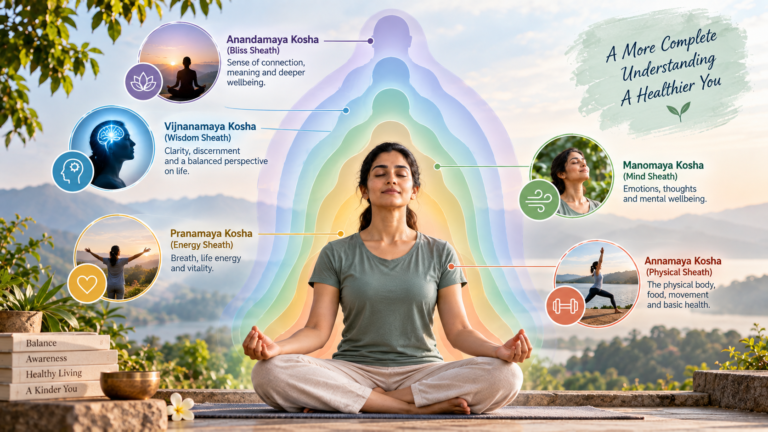
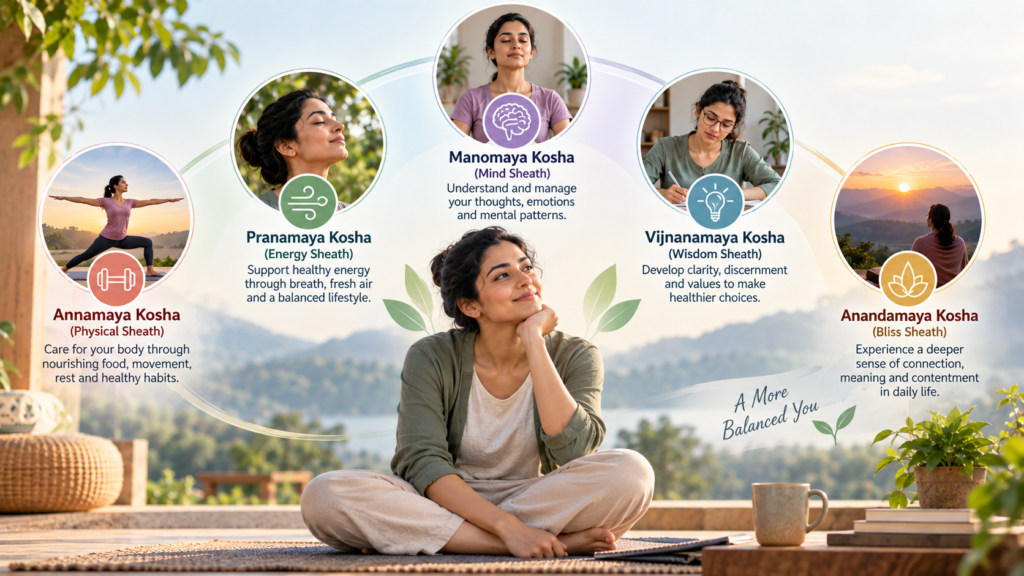
The traditional framework describes five koshas:
- Annamaya Kosha — the physical or food-based sheath
- Pranamaya Kosha — the vital-energy or life-force sheath
- Manomaya Kosha — the mental and emotional sheath
- Vijnanamaya Kosha — the discernment or wisdom sheath
- Anandamaya Kosha — the sheath associated traditionally with deeper contentment or bliss
These layers are described as progressively subtler aspects of human experience.
They should not be interpreted as five separate physical entities.
A more practical way to think about them is as five perspectives through which we can observe our experience and wellbeing.
Why Is Panchakosha Relevant Today?
Modern healthcare has developed highly specialised fields.
Cardiology focuses on the heart. Neurology focuses on the nervous system. Gastroenterology focuses on the digestive system. Psychiatry and psychology address mental and emotional health. Endocrinology examines hormones and metabolism.
Specialisation is enormously valuable because it allows complex problems to be studied in depth.
But the person experiencing the health problem remains one person.
Someone with chronic pain may also be struggling with sleep.
Someone with digestive symptoms may also be experiencing significant stress.
Someone recovering from illness may be physically improving while feeling emotionally exhausted.
Someone who appears physically healthy may nevertheless be experiencing profound psychological distress.
A whole-person perspective does not replace medical specialisation.
It complements it by asking:
What else is happening in this person’s life that may matter to their wellbeing?
The Five Koshas as a Practical Framework
Let’s explore each layer—not as anatomy, but as a way of paying attention.
1. Annamaya Kosha: The Physical Dimension
Annamaya Kosha is traditionally associated with the physical, food-based aspect of human existence.
At a practical level, this can invite us to consider the body.
How are we eating? How are we moving? How are we sleeping? How is our physical health? Are we experiencing pain or fatigue? Are we giving the body adequate nourishment and recovery?
These are ordinary questions, but they are fundamental.
Caring for the Physical Dimension
Practical foundations include:
- Balanced nutrition
- Appropriate hydration
- Regular physical activity
- Adequate sleep
- Personal hygiene
- Appropriate medical care
- Healthy body composition where relevant
- Avoidance of tobacco and other harmful substances
- Appropriate management of existing medical conditions
The physical dimension is often the place where people first notice that something is wrong.
But it is not necessarily the whole story.
2. Pranamaya Kosha: Breath, Vitality and Regulation
The second layer is Pranamaya Kosha, traditionally associated with prana, often translated as vital energy or life force.
Prana is a traditional yogic concept.
It should not simply be equated with oxygen, respiration, nervous-system activity or another single biomedical process.
Nevertheless, breathing provides an accessible modern point of connection.
We breathe continuously, often without conscious attention.
Breathing can also change with emotional and physical states.
When people are frightened or tense, breathing may become faster or more noticeable.
When relaxed, breathing may become slower and more comfortable.
Yoga uses conscious breathing practices to develop awareness and regulation.
A Simple Practice
Sit comfortably.
Notice the natural breath.
Do not force it.
Observe:
- The movement of the abdomen
- The movement of the chest
- The sensation of air entering and leaving
- The length and comfort of the breath
- Any unnecessary tension around the shoulders and face
After a few moments, allow the exhalation to become gently and comfortably longer than the inhalation.
There is no need for breath retention.
If you become dizzy or uncomfortable, return to normal breathing and stop the practice.
This is a simple example of bringing greater awareness to the breathing dimension of experience.
3. Manomaya Kosha: Mind and Emotional Experience
Manomaya Kosha is traditionally associated with the mind, sensory experience and emotional responses.
This dimension is especially relevant to modern discussions of mental wellbeing.
What thoughts occupy your attention? How do you respond to difficult situations? Do you tend to ruminate? Are you able to relax? How do emotions influence your body?
These questions can help us recognise that mental wellbeing is not separate from everyday health.
The Mind–Body Relationship
Consider what can happen during a stressful period.
You may:
- Sleep less
- Eat differently
- Breathe differently
- Move less
- Experience muscle tension
- Notice digestive changes
- Become more irritable
- Find concentration more difficult
None of this means that every physical symptom is “just psychological.”
That would be an equally incomplete approach.
The important point is that physical and psychological experiences can influence each other.
Persistent physical symptoms deserve appropriate medical evaluation even when stress is also present.
4. Vijnanamaya Kosha: Discernment and Wise Choice
The fourth layer, Vijnanamaya Kosha, is traditionally associated with discernment, understanding and deeper wisdom.
In everyday language, we might use this layer as an invitation to ask:
Do I understand my own patterns well enough to make wiser choices?
For example: you know that sleeping five hours leaves you exhausted; you know that skipping meals leads to overeating later; you know that constant notifications make it difficult to concentrate; you know that certain situations repeatedly trigger stress.
Awareness is useful.
But awareness alone is not always enough.
We also need discernment.
Information Is Not the Same as Wisdom
We live in an age of enormous health information.
There are countless diets, supplements, exercise programmes, wellness trends and online health claims.
The challenge is no longer simply finding information.
It is determining:
- What is relevant?
- What is reliable?
- What is safe?
- What applies to me?
- What requires professional advice?
- What is supported by evidence?
This is where discernment becomes important.
A whole-person approach should not mean believing everything labelled “holistic.”
It should mean looking at the whole situation carefully.
5. Anandamaya Kosha: Deeper Contentment and Meaning
The fifth layer, Anandamaya Kosha, is traditionally associated with deeper contentment or bliss.
This is perhaps the most difficult kosha to translate into modern health language without oversimplifying it.
It should not be reduced to “being happy.”
A more careful interpretation can include questions about:
- Meaning
- Contentment
- Inner peace
- Connection
- Purpose
- Values
- A sense of belonging
- Deeper dimensions of human experience
These are deeply personal matters.
They cannot be measured simply by counting steps, checking blood pressure or measuring body weight.
Spiritual Wellbeing and Health
Spirituality can mean different things to different people.
For one person, it may involve religious faith.
For another, meditation or contemplative practice.
For another, connection with nature, service, meaning or a sense of purpose.
A whole-person health approach should respect these differences.
It should never impose a particular spiritual belief on a patient.
Similarly, spiritual practices should not be used to imply that a serious disease is caused by a person’s lack of spiritual development.
That can create unnecessary guilt and is not a responsible approach to healthcare.
Panchakosha Is Not Five Medical Systems
This distinction is important.
It would be inaccurate to say:
- Annamaya = musculoskeletal system
- Pranamaya = respiratory system
- Manomaya = brain
- Vijnanamaya = prefrontal cortex
- Anandamaya = a particular brain region
These are not established scientific equivalences.
Panchakosha comes from a different philosophical tradition.
We can use it as a whole-person reflective framework without pretending that it is a modern physiological model.
This distinction allows us to appreciate the framework while remaining scientifically responsible.
Applying Panchakosha to Everyday Health
The real value of a framework lies in whether it helps us ask better questions.
Imagine someone who feels tired every day.
A purely physical approach might ask:
What is happening physiologically?
That question is essential.
But the Panchakosha framework might encourage additional reflection.
Annamaya — How are sleep, food, movement and physical health?
Pranamaya — What does the person’s breathing and sense of physical vitality feel like?
Manomaya — Is there persistent stress, anxiety or emotional overload?
Vijnanamaya — Does the person understand their patterns and make informed choices?
Anandamaya — Do they experience meaning, connection or contentment in life?
None of these questions replaces medical investigation.
Together, they create a broader picture.
A Panchakosha Self-Reflection Exercise
You can use the five layers as a weekly check-in.
Physical — Annamaya
Ask: How is my body doing?
Consider: sleep, food, movement, pain, energy, medical concerns.
Breath and Vitality — Pranamaya
Ask: How does my breathing and physical energy feel?
Consider: breathing patterns, physical tension, energy throughout the day, recovery after activity.
Mind — Manomaya
Ask: What is happening in my mental and emotional world?
Consider: stress, worry, mood, emotional reactions, mental fatigue.
Discernment — Vijnanamaya
Ask: What am I learning about myself?
Consider: habits, choices, triggers, priorities, health information, decisions.
Meaning — Anandamaya
Ask: What gives my life meaning and contentment?
Consider: relationships, purpose, service, spirituality, gratitude, connection, personal values.
You do not need to have a perfect answer.
The purpose is awareness.
Panchakosha and Stress
Stress provides a particularly useful example of whole-person thinking.
Stress may be experienced across several dimensions.
Physical — Muscle tension, fatigue or headaches.
Breath — Changes in breathing patterns.
Mental — Worry, racing thoughts or difficulty concentrating.
Behaviour — Changes in eating, sleep, exercise or substance use.
Meaning — Feeling disconnected from purpose or overwhelmed by responsibilities.
A stress-management plan that addresses only one of these dimensions may leave important contributors untouched.
This is why I often find a whole-person framework useful when discussing wellbeing.
Panchakosha and Yoga
Yoga provides practical tools that can be considered alongside this framework.
Asana — Supports physical movement and body awareness.
Pranayama — Develops awareness of breathing within traditional yogic practice.
Relaxation — Creates opportunities for recovery.
Meditation — Cultivates attention and observation.
Self-reflection — Encourages greater awareness of thoughts, behaviours and choices.
The purpose is not to force every yoga practice into one kosha.
Rather, the framework can help us appreciate that yoga traditionally addresses more than the physical body.
A 15-Minute Panchakosha Practice
You can create a simple reflective practice from the five dimensions.
Minutes 1–3: Body — Sit or lie comfortably. Notice physical sensations without judging them.
Minutes 4–6: Breath — Observe your breathing. Allow it to become comfortable and natural.
Minutes 7–9: Mind — Notice thoughts and emotions without trying to eliminate them.
Minutes 10–12: Discernment — Ask: What does my body or mind need today?
Minutes 13–15: Meaning — Spend a few quiet moments reflecting on something that gives your life meaning, gratitude or connection.
This is not a medical treatment.
It is simply a structured self-awareness exercise inspired by the whole-person perspective.
Panchakosha and Digestive Health
The digestive system is a good example of why whole-person thinking can be useful.
Consider someone experiencing recurrent digestive discomfort.
The physical dimension may include: food, bowel habits, hydration, medical conditions, medications.
The breath and stress dimension may include: stress, breathing, physical tension.
The mental dimension may include: anxiety, worry about symptoms, emotional distress.
The behavioural dimension may include: eating too quickly, irregular meals, sedentary habits.
And the broader life dimension may include: work stress, social circumstances, sleep, sense of wellbeing.
This does not mean digestive symptoms are caused by emotional factors.
It means that a person’s experience of digestive health can be influenced by multiple dimensions.
Persistent or concerning symptoms still require appropriate medical assessment.
Panchakosha and Sleep
Sleep is similarly multidimensional.
Physical — Is the body comfortable?
Breath — Is breathing relaxed?
Mind — Is the mind racing?
Behaviour — Is there late-night screen use or irregular sleep timing?
Meaning — Is the person experiencing unresolved concerns that make it difficult to settle?
A whole-person sleep routine may therefore include:
- Regular sleep timing
- Appropriate physical activity
- Comfortable evening movement
- Reduced stimulation
- Relaxation
- Breath awareness
- Addressing persistent psychological stress
- Medical evaluation when indicated
Panchakosha and Preventive Health
Preventive health is often described through measurable factors such as:
- Blood pressure
- Blood glucose
- Cholesterol
- Weight
- Physical activity
- Nutrition
- Smoking
- Alcohol consumption
These are important.
But prevention also involves behaviour and context.
Can a person realistically follow the recommended lifestyle? Do they have adequate social support? Are they sleeping? Are they chronically stressed? Do they understand their health condition? Are they able to make informed decisions?
The Panchakosha framework can serve as a reminder that health behaviour happens within a human life—not in isolation.
Whole-Person Health Does Not Mean Treating Everything Holistically
The phrase “holistic health” is sometimes misunderstood.
It does not mean that every illness can be managed through lifestyle, yoga, meditation, diet or traditional remedies.
Some conditions require:
- Medication
- Surgery
- Emergency care
- Specialist treatment
- Physiotherapy
- Psychological therapy
- Diagnostic testing
- Long-term medical monitoring
A whole-person approach should make us more attentive to appropriate care, not less.
The question is not: “Can I avoid modern medicine?”
The better question is: “What combination of evidence-based medical care and supportive health practices is appropriate for this person?”
How I Think About Panchakosha in Contemporary Health
For me, Panchakosha is most useful when treated as a map for attention rather than a medical diagnostic system.
It encourages us to look at: Body; Breath and vitality; Mind and emotions; Understanding and choices; Meaning and deeper wellbeing.
It reminds us that a person is more than a diagnosis.
At the same time, the framework should remain grounded.
A traditional concept does not become scientifically established simply because it is meaningful or ancient.
Likewise, modern medicine does not become less important because human wellbeing has dimensions that cannot be captured by a laboratory test.
Both perspectives can be held thoughtfully.
A Simple Whole-Person Daily Check-In
At the end of each day, ask five questions:
1. Body — Did I care for my physical health today?
2. Breath — Did I give myself moments to slow down and breathe comfortably?
3. Mind — What emotions or thoughts were most present today?
4. Discernment — Did my choices reflect what I genuinely value?
5. Meaning — What gave me a sense of connection, gratitude or purpose today?
You can answer these in one or two sentences.
Over time, patterns may become visible.
Common Misunderstandings About Panchakosha
“The five koshas are physical layers of the body.” They are better understood as a traditional philosophical model of human experience, not anatomical structures.
“Each kosha corresponds to a specific organ.” There is no established scientific mapping of the five koshas to individual organs.
“Panchakosha can diagnose disease.” It should not be used as a replacement for clinical diagnosis.
“Spiritual wellbeing determines physical health.” Health is influenced by many factors, including biology, environment, behaviour, social circumstances and access to healthcare.
“A whole-person approach means avoiding medication.” No. Appropriate medication and medical treatment remain essential when indicated.
When Professional Healthcare Is Necessary
A whole-person approach should always include appropriate medical care.
Seek professional evaluation when symptoms are:
- New and unexplained
- Persistent
- Severe or worsening
- Affecting daily functioning
- Associated with significant weight loss
- Associated with bleeding
- Accompanied by persistent vomiting
- Associated with chest pain or severe breathlessness
- Associated with fainting
- Associated with significant neurological changes
Mental-health symptoms also deserve professional attention when they are persistent, severe or significantly affecting daily life.
Self-reflection is valuable.
It is not a substitute for healthcare.

A Practical Panchakosha Lifestyle Framework
You can translate the five dimensions into five everyday commitments.
This is not a medical prescription.
| Dimension | Everyday focus |
|---|---|
| Annamaya | Nourish and move the body |
| Pranamaya | Develop comfortable breath awareness |
| Manomaya | Care for mental and emotional wellbeing |
| Vijnanamaya | Develop informed, thoughtful choices |
| Anandamaya | Cultivate meaning, connection and contentment |
It is a practical way of remembering that wellbeing has multiple dimensions.
Five Habits for Whole-Person Wellbeing
You do not need an elaborate programme.
Start with:
Move — Give your body regular physical activity.
Breathe — Take moments during the day to notice and soften the breath.
Pause — Create space between activity and recovery.
Reflect — Notice patterns instead of operating entirely on autopilot.
Connect — Make time for relationships, purpose, gratitude or whatever gives your life meaning.
These simple habits can become the foundation for a more conscious lifestyle.
Frequently Asked Questions
What are the five koshas?
The five koshas described in the traditional Panchakosha framework are Annamaya, Pranamaya, Manomaya, Vijnanamaya and Anandamaya.
Is Panchakosha scientifically proven?
Panchakosha is a traditional philosophical and contemplative framework rather than a scientifically validated anatomical or diagnostic model. Individual practices associated with yoga, relaxation, physical activity and healthy lifestyle may have varying levels of modern evidence, but that evidence should not be used to claim that the five koshas themselves have been scientifically established.
Is Panchakosha part of yoga?
Panchakosha is rooted in the Upanishadic philosophical tradition and has been incorporated into some modern yoga and yoga-therapy approaches. Its interpretation can vary across traditions.
Can Panchakosha be used to treat disease?
It should not be used as a substitute for medical diagnosis or treatment. It may instead be used as a framework for self-awareness and whole-person wellbeing alongside appropriate healthcare.
Is Pranamaya Kosha the same as the respiratory system?
No. Pranamaya Kosha is a traditional concept associated with prana or vital energy. It should not be equated directly with the anatomical respiratory system.
Is Anandamaya Kosha the same as happiness?
Not necessarily. Anandamaya Kosha is traditionally associated with deeper bliss or contentment. Reducing it simply to everyday happiness would oversimplify the philosophical concept.
Can Panchakosha help with stress?
As a reflective framework, it can encourage attention to physical health, breathing, mental wellbeing, decision-making and meaning. It should be considered one supportive perspective rather than a treatment for a stress-related disorder.
How can I start exploring Panchakosha?
Begin with the five questions in this article. Observe your body, breathing, mind, choices and sense of meaning. You do not need to adopt a complicated spiritual practice to begin.
Final Thoughts
The most important lesson I take from Panchakosha is not that there are five separate layers of a human being.
It is that human wellbeing cannot always be understood by looking at only one dimension of life.
The body matters. The breath matters. The mind matters. Our ability to understand and make choices matters. And for many people, meaning, connection and inner contentment matter too.
Modern medicine gives us powerful tools for understanding and treating disease. Nutrition, exercise science, psychology, public health and other disciplines add further dimensions to our understanding of wellbeing.
Traditional frameworks such as Panchakosha offer another language—one rooted in a different philosophical tradition—for reflecting on the whole person.
The opportunity lies in using that framework responsibly.
Not turning it into anatomy. Not turning it into a diagnostic system. Not claiming that traditional concepts automatically have modern scientific validation.
But also not overlooking the valuable question it encourages us to ask:
How can we care for the whole human being while remaining grounded in evidence, compassion and appropriate healthcare?
For me, that is where Panchakosha becomes especially meaningful.
It is not a replacement for medicine.
It is a reminder to look beyond the diagnosis and remember the person.
Whole-person health begins with whole-person attention.
Related Reading
Visit the Holistic & Integrative Health topic page for the full range of related content on this site.
The following related articles are part of the approved content corpus; several are not yet migrated to WordPress and are listed here as plain text rather than linked, per the project’s no-fabricated-link rule.
- Panchakosha: Understanding Health Through a Whole-Person Perspective
- Yoga for Health: A Practical Guide to Movement, Breath, Mind and Whole-Person Wellbeing
- Yoga for Stress Management: Practices for Relaxation, Awareness and Better Wellbeing
- Ayurveda and Daily Routine: Understanding Dinacharya for Everyday Wellbeing
- Ayurvedic Diet: Traditional Principles for Everyday Health and Whole-Person Wellbeing
- Stress and Anxiety: Understanding the Mind–Body Connection and Supporting Better Health
- Relaxation Techniques for Stress: Breathing, Body Awareness and Mindfulness
- Sleep and Mental Wellbeing: Understanding the Mind–Body Connection
- Understanding the Gut–Brain Connection: How Stress, Emotions and Digestion Interact
- Holistic Health: A Practical Guide to Whole-Person Wellbeing
- Integrative Medicine and Holistic Health: Bringing the Whole Person Into Healthcare
Medical Disclaimer
This article is intended for general educational and wellbeing purposes. It is not a substitute for individual medical diagnosis, treatment or professional advice.
Panchakosha is a traditional philosophical framework and should not be interpreted as a modern anatomical, physiological or diagnostic model. Yoga, meditation, breathing practices, Ayurveda and other traditional approaches may complement appropriate healthcare, but they should not replace necessary medical evaluation or evidence-based treatment.
If you have persistent, severe or unexplained symptoms, or if you have a diagnosed medical or mental-health condition, consult an appropriately qualified healthcare professional.