
Introduction
Healthcare is often organized around diseases.
A person may visit a cardiologist for the heart, a gastroenterologist for digestion, an endocrinologist for metabolism, a psychiatrist for mental health, or a physiotherapist for movement.
Specialization is one of the great strengths of modern medicine. It allows healthcare professionals to develop deep expertise in particular areas of the human body and specific medical conditions.
But the person sitting in front of us is never divided into separate departments.
A patient with diabetes may also be experiencing stress and poor sleep. A person with digestive symptoms may also have anxiety, dietary challenges and a sedentary lifestyle. Someone recovering from surgery may need not only medical treatment but also nutrition, movement, emotional support and gradual rehabilitation. A person living with a chronic illness may require medical care for years while simultaneously trying to maintain relationships, work, purpose and quality of life.
This is where the idea of integrative medicine and whole-person health becomes important.
Integrative health does not mean rejecting modern medicine. It does not mean replacing medicines with natural remedies. It does not mean assuming that every disease can be solved through lifestyle.
Instead, a responsible integrative approach asks:
How can we provide appropriate medical care while also addressing the lifestyle, behavioural, psychological, social and personal dimensions that influence health and wellbeing?
That question is at the heart of whole-person healthcare.
What Is Integrative Medicine?
The term integrative medicine is used in different ways across healthcare systems and professional settings.
At its most useful, integrative medicine can be understood as an approach that combines appropriate conventional medical care with selected complementary approaches, while considering the person’s broader health and wellbeing.
The central principles are:
- evidence;
- safety;
- individualized care;
- patient preferences;
- prevention;
- lifestyle;
- appropriate medical treatment; and
- coordination between different approaches.
The important word is integrative. The goal is not to create two competing systems. The goal is to determine what is appropriate for the individual.
Integrative Medicine Is Not “Alternative Medicine”
The distinction is important.
Alternative medicine can imply using an approach instead of conventional medical treatment. For serious conditions, replacing effective medical treatment with an unproven alternative can be dangerous.
Complementary approaches, on the other hand, may sometimes be used alongside conventional care. For example, depending on the individual and clinical situation:
- yoga may complement physical activity or stress-management strategies;
- meditation may complement psychological care;
- nutrition counselling may complement treatment of metabolic disease;
- breathing practices may complement relaxation strategies; and
- appropriately selected traditional practices may support wellbeing.
These approaches should never automatically replace necessary medical evaluation or treatment.
Modern Medicine Remains Fundamental
A whole-person approach begins by respecting the importance of modern medical care.
Modern medicine provides tools for:
- diagnosis;
- emergency treatment;
- infection management;
- surgery;
- cancer care;
- cardiovascular care;
- treatment of endocrine disorders;
- neurological care;
- mental healthcare;
- pain management;
- rehabilitation;
- preventive screening;
- vaccination; and
- evidence-based medications.
When a serious disease is present, appropriate medical treatment should not be delayed because someone prefers a “natural” approach.
Integrative health should strengthen responsible healthcare — not undermine it.
What Does “Holistic” Actually Mean?
The word holistic is often used loosely. It can sometimes be associated with wellness marketing, alternative treatments or generalized claims about natural healing.
But at its most practical, holistic means considering the whole. In healthcare, that may include:
Physical health
What is happening in the body?
Mental and emotional health
How is the person thinking and feeling?
Lifestyle
How are they eating, sleeping and moving?
Social health
What relationships and circumstances affect them?
Behaviour
What habits are helping or harming health?
Environment
What aspects of their surroundings influence health?
Meaning and values
What matters to this person?
A holistic perspective therefore does not necessarily require a traditional medical system. It requires a willingness to see the person in context.
Disease-Centred vs Person-Centred Care
Traditional medical practice can sometimes become highly disease-focused. For example:
“This is hypertension. Here is the treatment.”
A whole-person conversation may add:
“How is your blood pressure affecting your life?”
“What is your diet like?”
“How active are you?”
“How do you sleep?”
“What medications are you already taking?”
“What barriers make lifestyle changes difficult?”
“What matters most to you?”
The diagnosis remains important. But the person becomes part of the treatment plan.
The Five Dimensions of Whole-Person Health
A useful integrative framework is to consider five broad dimensions.
1. Physical Health
This includes:
- medical conditions;
- nutrition;
- fitness;
- movement;
- sleep;
- symptoms;
- medications; and
- preventive care.
This is the foundation of clinical medicine.
2. Breath and Physiological Regulation
Breathing is closely connected with physical activity, stress and autonomic regulation. A person may notice that their breathing changes when they are:
- anxious;
- exercising;
- concentrating;
- frightened; or
- exhausted.
Breathing awareness and appropriate practices can therefore become useful components of self-regulation. This does not mean breathing exercises can treat every medical condition. They are one tool among many.
3. Mental and Emotional Health
Health includes psychological wellbeing. This may involve:
- stress;
- anxiety;
- mood;
- resilience;
- emotional regulation;
- attention;
- coping; and
- relationships.
Persistent or severe mental-health symptoms deserve appropriate professional assessment. Lifestyle practices can complement mental healthcare, but they should not be presented as universal substitutes for evidence-based treatment.
4. Behaviour and Discernment
Health depends partly on the decisions people make every day. These include:
- what they eat;
- how much they move;
- whether they smoke;
- how they manage alcohol;
- when they seek medical care;
- whether they take prescribed medication; and
- what health information they trust.
Health literacy therefore becomes an important component of healthcare.
5. Meaning and Quality of Life
Finally, health is not simply about extending life. It is also about living well. People care about:
- relationships;
- independence;
- family;
- work;
- creativity;
- contribution;
- spirituality;
- purpose;
- dignity; and
- quality of life.
These dimensions may not always appear on a laboratory report, but they can profoundly influence how people experience health and illness. This connects with the Panchakosha framework discussed in Panchakosha: Understanding Health Through a Whole-Person Perspective.
Evidence Should Remain the Foundation
Integrative medicine should not mean accepting every traditional or complementary practice simply because it is old, popular or natural. Every intervention should be considered in terms of:
- evidence of benefit;
- potential risks;
- quality of evidence;
- appropriate dosage or intensity;
- individual circumstances;
- interactions with existing treatment;
- opportunity cost; and
- patient preferences.
The evidence for different complementary approaches varies considerably. Some interventions have substantial evidence for particular uses. Others have limited or uncertain evidence. Some may have potential risks.
This means an integrative approach requires discernment.
“Natural” Does Not Mean “Risk-Free”
One of the most important principles in integrative healthcare is:
Natural is not synonymous with safe.
Plants contain biologically active compounds. Herbal preparations can interact with medications. Supplements can vary in quality. Some products may be contaminated or incorrectly labelled. Certain concentrated preparations can affect the liver, kidneys, blood clotting or other physiological systems.
Therefore, patients should tell their healthcare professionals about:
- herbal medicines;
- supplements;
- traditional preparations;
- over-the-counter products;
- special diets; and
- fasting practices.
This information can be clinically important.
Ayurveda and Integrative Health
Ayurveda is a traditional Indian system of health and medicine with a long history. Its frameworks include concepts such as:
- Prakriti;
- doshas;
- Agni;
- dietary practices;
- daily routines;
- seasonal routines; and
- herbal preparations.
These concepts belong to the traditional Ayurvedic framework. They should not automatically be treated as equivalent to modern physiological or medical concepts.
At the same time, some traditional practices may provide useful perspectives on:
- food;
- routine;
- mindful eating;
- lifestyle;
- self-observation; and
- wellbeing.
The appropriate approach is neither blind acceptance nor blanket rejection. It is careful evaluation.
Yoga and Integrative Health
Yoga provides another important bridge. Modern yoga practice can include:
- physical postures;
- mobility;
- balance;
- strength;
- breathing;
- relaxation;
- meditation; and
- attention.
Depending on the practice and the individual, yoga may complement broader approaches to:
- physical activity;
- stress management;
- flexibility;
- balance;
- sleep; and
- wellbeing.
However, yoga should not be presented as a universal treatment for disease. A person with a serious medical condition may need medical treatment first and may require a modified yoga practice. Safety and individualization matter. See Yoga for Health and Recommended Yoga Practices for Digestive Health.
Mind–Body Practices
The mind and body continuously interact.
Stress can influence:
- sleep;
- digestion;
- appetite;
- muscle tension;
- pain;
- heart rate; and
- breathing.
Physical illness can influence:
- mood;
- anxiety;
- confidence;
- relationships; and
- quality of life.
Mind–body practices can therefore be useful as part of a broader health plan. Examples include:
- breathing exercises;
- meditation;
- mindfulness;
- yoga;
- relaxation practices;
- appropriate physical activity; and
- social connection.
Their role depends on the individual and the clinical context.
Lifestyle Is Clinical Medicine Too — In the Right Context
Lifestyle is sometimes presented as if it were an optional wellness activity. But lifestyle factors can have major effects on health. Important areas include:
Nutrition
A balanced dietary pattern supports physical health and can contribute to management of many chronic conditions.
Physical activity
Movement supports cardiovascular, metabolic, musculoskeletal and mental health.
Sleep
Adequate sleep is important for physical and psychological functioning.
Stress management
Persistent stress can affect behaviour, sleep, mood and physical symptoms.
Tobacco
Avoiding tobacco is one of the most important preventable health measures.
Alcohol
Alcohol use can affect multiple aspects of health, and moderation or avoidance may be appropriate depending on the individual.
Social connection
Relationships and social support are important dimensions of wellbeing.
The goal is not to create a perfect lifestyle. It is to build sustainable habits.
Prevention: One of the Most Important Forms of Integrative Health
Healthcare often becomes focused on treating illness after it appears. A whole-person approach also asks:
What can we do before disease develops or progresses?
Preventive health may include:
- appropriate screening;
- vaccination;
- healthy nutrition;
- physical activity;
- sleep;
- tobacco avoidance;
- appropriate alcohol use;
- weight and metabolic health;
- blood pressure monitoring;
- mental-health care;
- dental health; and
- regular medical follow-up.
Prevention is not about eliminating every health risk. It is about reducing avoidable risk while recognizing that not everything is under individual control.
The Importance of Individualization
There is no universal integrative-health plan. A young athlete and an older adult with multiple medical conditions should not receive identical advice. Neither should:
- a pregnant woman;
- a child;
- someone recovering from surgery;
- a person taking multiple medications;
- someone with kidney disease;
- someone with significant digestive disease; or
- someone with a mental-health condition.
Individualization means considering:
- age;
- medical history;
- medications;
- lifestyle;
- nutrition;
- preferences;
- cultural background;
- physical ability;
- goals;
- risks; and
- evidence.
Patient Preferences Matter
Healthcare is not simply about what a clinician recommends. Patients bring their own:
- values;
- beliefs;
- experiences;
- concerns;
- priorities; and
- cultural practices.
For example, a patient may prefer:
- vegetarian food;
- yoga;
- meditation;
- traditional dietary practices;
- structured exercise; or
- lifestyle counselling.
These preferences can sometimes be incorporated into care. But preference should not override safety. A patient’s preference for an unproven treatment does not make it proven.
The clinician’s role is to explain the evidence, benefits, risks and alternatives so that decisions can be made thoughtfully.
Shared Decision-Making
Integrative healthcare works best when patients and clinicians work together. A useful conversation may include:
What is happening?
Understanding the diagnosis or symptoms.
What are the options?
Discussing available treatments and lifestyle approaches.
What are the benefits?
Considering likely benefits and evidence.
What are the risks?
Considering side effects, interactions and possible harms.
What matters to the patient?
Understanding preferences, priorities and circumstances.
What is realistic?
Creating a plan the person can actually follow.
This approach respects both medical expertise and patient autonomy.
A Practical Integrative Health Framework
When considering a health concern, ask seven questions.
1. What needs medical assessment?
Do not overlook diagnosis.
2. What can lifestyle contribute?
Consider food, activity, sleep and behaviour.
3. What is happening psychologically?
Assess stress, mood and coping.
4. What is happening socially?
Consider family, work, finances and support.
5. Are there safe complementary practices?
Only consider approaches appropriate to the individual.
6. What evidence supports each approach?
Separate established evidence from tradition, theory and marketing.
7. What can realistically be sustained?
A sustainable plan is more useful than an idealized one.
Integrative Care for Digestive Health
Digestive health provides a good example of how this model can work. Imagine someone with recurrent bloating. A responsible approach might include:
Medical assessment
Consider whether there are warning signs or an underlying condition requiring evaluation.
Nutrition
Review meal patterns, food variety, fibre, portions and potential dietary triggers.
Bowel habits
Assess constipation, diarrhoea or changes in bowel pattern.
Movement
Encourage appropriate physical activity.
Stress
Explore whether symptoms fluctuate with stress.
Sleep
Consider sleep quality and routine.
Mind–body practices
Breathing, yoga or relaxation may be considered where appropriate.
Traditional practices
Ayurvedic dietary principles may provide additional lifestyle perspectives, while herbal treatments require careful safety evaluation.
No single component needs to explain everything.
Integrative Care for Stress and Anxiety
A whole-person approach to persistent stress might include:
Medical assessment
Determine whether symptoms require clinical evaluation.
Psychological care
Consider counselling or other appropriate evidence-based mental-health treatment.
Lifestyle
Address sleep, activity, nutrition and routines.
Breathing
Use comfortable breathing practices when appropriate.
Yoga or movement
Choose practices suited to the individual’s physical condition.
Social connection
Strengthen supportive relationships.
Daily structure
Create manageable routines.
Meaning
Identify values, purpose and activities that provide fulfilment.
This is much broader than simply telling someone to “relax.”
Integrative Care Does Not Mean Doing Everything
There is a common misconception that holistic health requires adding more and more interventions.
In reality, good integrative care may involve doing less.
A person may not need:
- ten supplements;
- a complicated diet;
- multiple detox programs;
- several daily rituals; or
- expensive wellness products.
They may need:
- appropriate diagnosis;
- a few important lifestyle changes;
- one useful exercise routine;
- better sleep;
- psychological support;
- medication when indicated; and
- regular follow-up.
Simplicity is often an important part of sustainability.
The 80% Principle
Health does not need to be perfect. A useful practical principle is:
Aim for consistency rather than perfection.
Eat well most of the time. Move regularly. Protect sleep. Manage stress. Take prescribed medication appropriately. Attend recommended follow-ups. Make room for enjoyment and flexibility.
One difficult day does not erase months of healthy habits.
The Role of the Doctor
In an integrative model, the doctor is not simply someone who prescribes medicines. The doctor may also function as:
- diagnostician;
- educator;
- risk assessor;
- guide;
- listener;
- coordinator; and
- partner in decision-making.
This does not mean the doctor must personally deliver every component of a person’s care. An integrative approach may involve collaboration with:
- dietitians;
- physiotherapists;
- psychologists;
- psychiatrists;
- yoga professionals;
- exercise professionals; and
- other appropriately qualified practitioners.
The important question is whether the overall care is coordinated and safe.
Avoiding Fragmented Care
One challenge with multiple practitioners is fragmentation. Imagine a patient taking:
- prescription medicines;
- herbal preparations;
- supplements; and
- dietary products;
while simultaneously following several different health programs.
If nobody knows the complete picture, interactions and conflicting advice can occur. A coordinated medical record and clear communication are therefore valuable.
Patients should be encouraged to tell their healthcare professionals about all treatments and supplements they use.
Integrative Health and Chronic Disease
Chronic conditions often require long-term thinking. Examples include:
- diabetes;
- hypertension;
- obesity;
- chronic digestive disorders;
- arthritis;
- chronic pain;
- cardiovascular disease; and
- respiratory disease.
These conditions may involve multiple interacting factors. Medical treatment may be essential. But long-term outcomes can also be influenced by:
- nutrition;
- physical activity;
- sleep;
- stress;
- adherence;
- social support;
- mental health; and
- health literacy.
This is where whole-person care can be particularly useful.
Integrative Health and Quality of Life
Clinical success is not always measured only by laboratory values.
Consider someone living with chronic pain. Their treatment may be successful if:
- pain becomes more manageable;
- sleep improves;
- movement increases;
- confidence improves; and
- they return to meaningful activities.
Similarly, someone with digestive symptoms may care not only about symptom frequency but also about being able to:
- eat without fear;
- travel;
- work comfortably;
- participate socially; and
- sleep well.
Quality of life is an important health outcome.
What Integrative Medicine Should Not Promise
Responsible integrative health avoids exaggerated claims. It should not promise that:
- every disease can be cured naturally;
- detoxification removes all disease-causing substances;
- one diet works for everyone;
- one supplement can treat multiple unrelated diseases;
- yoga can replace necessary medical treatment;
- Ayurveda can replace emergency care;
- positive thinking prevents illness; or
- spirituality guarantees health.
Such claims can create false hope and may delay appropriate care.
Good integrative medicine requires humility.
The Importance of Evidence
When evaluating a complementary practice, consider the strength of evidence. A useful hierarchy of questions is:
Is there a plausible mechanism?
Interesting, but not enough by itself.
Has it been studied?
Research is necessary.
What kind of research?
A small laboratory study is different from a well-designed clinical trial.
Does it improve meaningful outcomes?
A biological effect is not necessarily a meaningful clinical benefit.
Is it safe?
Potential benefits must be weighed against potential harms.
Does it interfere with established treatment?
This is especially important for medicines and supplements.
Evidence-based care does not mean rejecting tradition. It means understanding what we know — and what we do not know.
Tradition and Science Can Have Different Roles
Traditional knowledge may offer:
- practices;
- observations;
- cultural wisdom;
- lifestyle principles; and
- philosophical frameworks.
Science provides methods for testing:
- effectiveness;
- safety;
- mechanisms; and
- reproducibility.
A traditional practice can be worth studying without being assumed to be effective. Likewise, a scientifically studied intervention can be useful without having traditional roots.
The goal is responsible integration.
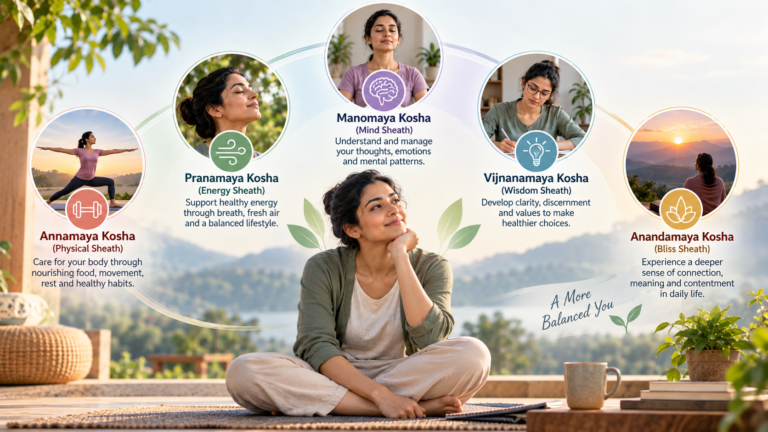
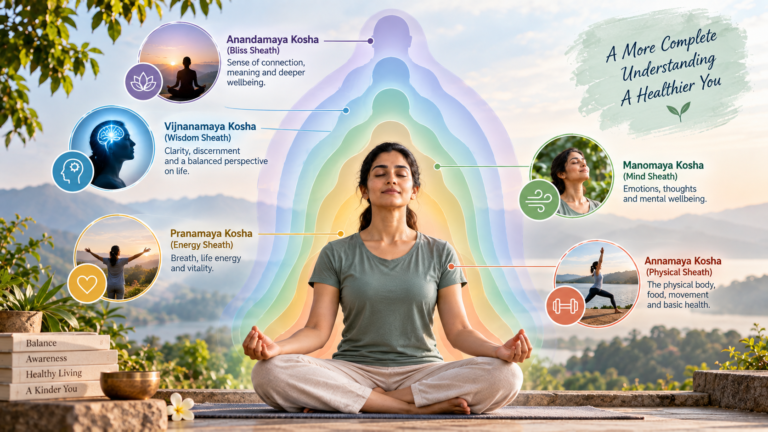
Panchakosha as a Whole-Person Lens
The Panchakosha framework provides a useful philosophical complement to integrative health. It invites attention to:
Annamaya — physical wellbeing.
Pranamaya — breath and vitality.
Manomaya — mental and emotional experience.
Vijnanamaya — discernment and understanding.
Anandamaya — deeper wellbeing and meaning.
These should not be interpreted as scientifically established biological layers. Instead, they can help us remember that healthcare involves more than disease management.
From Holistic Thinking to Practical Action
Holistic health becomes meaningful only when it changes what we do. A practical daily framework might look like:
Morning
- Wake at a reasonably consistent time.
- Hydrate according to individual needs.
- Spend a few moments checking how you feel.
- Include movement or breathing if appropriate.
During the day
- Eat balanced meals.
- Move regularly.
- Take appropriate breaks.
- Manage stress before it accumulates.
Evening
- Eat a comfortable dinner.
- Reduce unnecessary stimulation.
- Reflect on the day.
- Prepare for adequate sleep.
Weekly
- Review your habits.
- Plan physical activity.
- Make time for relationships.
- Assess whether any symptoms need attention.
- Adjust gradually rather than radically.
A Whole-Person Health Audit
Once a week, ask yourself:
Body
Am I nourishing and moving my body appropriately?
Breath
Do I notice comfortable, natural breathing?
Mind
How is my stress and emotional wellbeing?
Relationships
Do I have meaningful social connection?
Habits
Which behaviours support my health?
Information
Am I following reliable health advice?
Medical care
Are there screenings, medications or follow-ups I should not postpone?
Meaning
Am I making time for what matters to me?
This is not a medical assessment. It is a self-reflection tool.
When Medical Evaluation Should Come First
Whole-person health should never become an excuse to postpone medical care. Seek appropriate medical attention for symptoms such as:
- new or severe chest pain;
- severe difficulty breathing;
- fainting;
- sudden neurological symptoms;
- significant bleeding;
- severe or persistent abdominal pain;
- persistent vomiting;
- unexplained weight loss;
- difficulty swallowing;
- rapidly worsening symptoms; and
- other potentially serious symptoms.
Likewise, persistent symptoms that interfere with daily life deserve evaluation even if they appear to be related to stress or lifestyle.
The whole person includes the physical body. That body deserves proper medical attention.
Frequently Asked Questions
Is integrative medicine the same as alternative medicine?
No. Alternative medicine generally implies replacing conventional care. Integrative medicine aims to combine appropriate conventional treatment with selected complementary approaches when they are safe and useful.
Does integrative medicine reject modern medicine?
No. A responsible integrative approach recognizes the importance of diagnosis, emergency care, medications, surgery, screening and evidence-based treatment.
Is holistic health scientifically proven?
“Holistic health” is a broad concept rather than a single treatment. Some components, such as physical activity, nutrition, sleep and psychological interventions, have substantial evidence for specific uses. Other complementary practices have more variable evidence.
Can Ayurveda be part of integrative care?
It can be considered as part of an integrative conversation, particularly around traditional dietary and lifestyle practices, provided safety, evidence and individual circumstances are considered.
Can yoga replace exercise?
Yoga can provide movement, strength, flexibility and balance depending on the practice, but it does not necessarily replace all forms of physical activity for every individual.
Can meditation replace mental-health treatment?
No. Meditation may complement mental-health care for some people, but significant or persistent mental-health conditions may require professional assessment and evidence-based treatment.
Is a healthy lifestyle enough to prevent disease?
No lifestyle can eliminate all disease risk. Genetics, environment, infections, ageing, chance and other factors also influence health.
Does integrative care mean taking supplements?
No. Supplements are optional interventions and are not automatically beneficial. Some can interact with medicines or cause harm.
A Simple Definition of Integrative Health
If we wanted to express the idea simply:
Integrative health is the practice of caring for the whole person by combining appropriate medical care with evidence-informed attention to lifestyle, mind–body wellbeing, prevention, personal values and individual circumstances.
The emphasis should always remain on appropriate care. Not every person needs every intervention. Not every traditional practice is effective. Not every medical problem can be solved through lifestyle. And not every health concern requires a medical intervention.
Good healthcare requires knowing the difference.
My Approach to Integrative Health
My approach begins with a simple principle:
Start with the person, understand the problem, use appropriate medical science, and then consider the wider dimensions of health that can support long-term wellbeing.
That may include:
- appropriate diagnosis;
- evidence-based treatment;
- nutrition;
- physical activity;
- sleep;
- stress management;
- breathing;
- yoga;
- carefully considered traditional practices;
- patient education;
- prevention;
- behavioural change;
- meaningful relationships; and
- quality of life.
The exact combination should depend on the person. Integrative healthcare should never become a predetermined package. It should remain individualized.
The Bigger Picture
Modern healthcare has become extraordinarily sophisticated. We can measure increasingly subtle biological changes. We have powerful medications and procedures. We can diagnose conditions earlier and treat diseases that were once difficult to manage.
Yet healthcare is ultimately still about people.
A patient does not experience their illness as a laboratory value. They experience it through their body, emotions, relationships, work, family, hopes and fears.
That is why whole-person thinking matters. It reminds us that good healthcare is not only about treating disease. It is also about helping people live as fully and meaningfully as their health circumstances allow.
Conclusion
Integrative medicine and holistic health are best understood not as alternatives to modern medicine, but as approaches that encourage us to look more completely at the person receiving care.
Modern medicine gives us the tools to diagnose and treat disease. Lifestyle medicine helps address everyday behaviours that influence health. Mind–body practices can support regulation, awareness and wellbeing. Yoga can contribute movement, breathing and attention. Ayurveda offers a traditional perspective on food, routine and individualized living. Panchakosha provides a philosophical framework for considering different dimensions of human experience.
Each has its own context, strengths and limitations. The responsibility of integrative healthcare is to bring these perspectives together carefully — without exaggerating evidence, dismissing tradition, or compromising medical safety.
Ultimately, the goal is simple:
Understand the person.
Treat disease appropriately.
Support healthy habits.
Respect individual values.
Use evidence wisely.
Prevent what can be prevented.
And help each person move toward the best level of health and wellbeing that is realistically possible.
Explore the Whole-Person Health Series
Visit the Holistic & Integrative Health topic page for the full range of related content on this site.
The following related articles are part of the approved content corpus; several are not yet migrated to WordPress and are listed here as plain text rather than linked, per the project’s no-fabricated-link rule.
- Holistic Health: A Practical Guide to Whole-Person Wellbeing (the merged AU-007/HH-001 cornerstone, per the P4-24/25 decision to merge the two original near-duplicate articles into one)
- PC-001 — Panchakosha: Understanding Health Through a Whole-Person Perspective
- YG-001 — Yoga for Health
- AY-001 — Ayurvedic Diet
- MB-001 — Stress and Anxiety: Understanding the Mind–Body Connection
- MB-008 — Breathing Patterns & States of Mind
- DG-005 — Understanding the Gut–Brain Connection
- AU-010 — Dr. Sarang Patil’s Approach to Integrative Health
- SS-001 — Sampurna Swasthya
Final Reflection
Healthcare becomes more complete when we treat the disease without losing sight of the person.
That is the central idea behind integrative, whole-person health.