
Good digestive health is not built through a single “detox,” a special drink or one perfect diet.
It is built through small, repeatable habits.
How we eat, how quickly we eat, how much we move, how well we sleep, how we respond to stress and how regularly we listen to our body’s signals can all influence digestive wellbeing.
The challenge is that health advice can sometimes become overwhelming.
You may hear that you need to eliminate certain foods, take multiple supplements, follow a complicated diet or completely change your lifestyle.
You usually do not need to do everything at once.
A better starting point is to build a few sustainable habits and observe how your body responds.
This 7-Day Digestive Fitness Starter Plan is designed as a simple introduction.
It is not a restrictive diet or a treatment plan. It is a structured week of practical habits that can help you become more aware of your digestive routine and identify areas that may benefit from improvement.
Important: This plan is for general health education. It is not intended to diagnose or treat digestive disease. If you have persistent, severe, worsening or unexplained digestive symptoms, seek appropriate medical evaluation.
What does “digestive fitness” mean?
We often think about fitness only in terms of muscles, strength, flexibility or cardiovascular health.
But the digestive system also functions as part of the body’s larger physiological network.
Digestive wellbeing involves several interconnected factors, including:
- digestion and absorption of nutrients,
- regular bowel function,
- appropriate movement through the digestive tract,
- dietary variety,
- hydration,
- physical activity,
- sleep,
- stress regulation,
- and the interaction between the digestive system and nervous system.
Digestive fitness therefore does not mean having a completely symptom-free digestive system every day.
It means developing habits that support healthy digestive function while paying attention to changes that may require medical evaluation.
The seven foundations
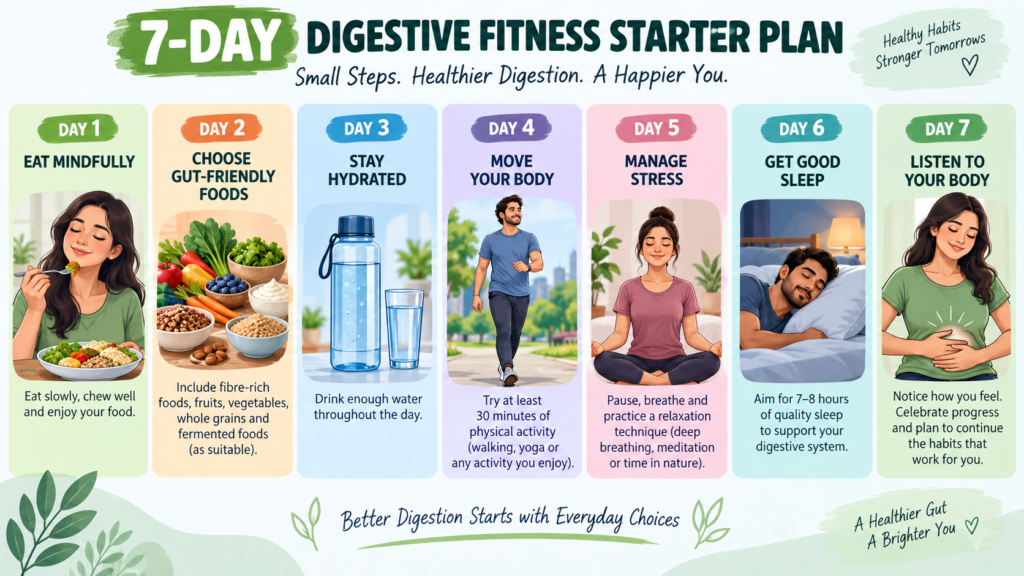
During the next seven days, we will focus on:
Day 1 — Awareness. Understand your current digestive pattern.
Day 2 — Eating Rhythm. Slow down and become more aware of meals.
Day 3 — Food Quality & Variety. Build a more diverse, balanced eating pattern.
Day 4 — Hydration & Bowel Routine. Support regular bowel habits.
Day 5 — Movement. Use physical activity to support overall digestive wellbeing.
Day 6 — Gut–Brain Balance. Work with stress, breathing and relaxation.
Day 7 — Integration. Create a realistic routine you can continue.
The purpose is not perfection.
The purpose is consistency.
Day 1: Observe Before You Change
Your first task: become aware
Many people immediately try to fix a digestive symptom.
Before changing everything, spend one day simply observing.
Notice:
- What time do you wake up?
- When do you eat?
- How quickly do you eat?
- How large are your meals?
- How much do you move?
- When do you experience bloating, acidity or discomfort?
- How regularly do you pass stool?
- How well do you sleep?
- What happens to your digestion during stressful periods?
You do not need to judge these patterns.
Just observe them.
Start a simple digestive diary
Record:
| Area | What to notice |
|---|---|
| Meals | Timing and approximate size |
| Food | Main foods and beverages |
| Symptoms | Bloating, acidity, discomfort, nausea etc. |
| Bowel habits | Frequency and significant changes |
| Movement | Walking/exercise |
| Stress | Low, moderate or high |
| Sleep | Duration and quality |
| Medicines | Regular or occasional use |
This information can become surprisingly useful.
You may discover that symptoms are associated with large meals, irregular eating, poor sleep, prolonged sitting or stressful periods.
You may also discover that there is no obvious single trigger.
Both observations are useful.
Day 1 goal: Observe without overreacting.
Day 2: Slow Down Your Meals
One of the simplest digestive habits is also one of the easiest to overlook:
How you eat matters, not only what you eat.
Eating rapidly can make it easier to consume large amounts of food before you notice fullness. It may also increase swallowed air in some people.
Try making today’s meals more deliberate.
Practice the “pause”
Before beginning your meal:
- Sit down.
- Put away unnecessary distractions if possible.
- Take a few comfortable breaths.
- Look at your food.
- Begin eating at a relaxed pace.
During the meal:
- chew comfortably,
- avoid rushing,
- notice taste and texture,
- pause occasionally,
- and pay attention to fullness.
You do not need to count chews.
The goal is simply to move from automatic eating to attentive eating.
Avoid turning mindful eating into another rule
Mindful eating should not become stressful.
You do not need perfect silence, perfect posture or a long meditation before every meal.
Even a small pause can change the experience.
Day 2 goal: Eat more slowly and with greater awareness.
Day 3: Improve Food Variety
A healthy digestive pattern is not necessarily about finding a single “superfood.”
It is about the overall pattern of eating.
Where appropriate for your individual needs, aim for variety across foods such as:
- vegetables,
- fruits,
- whole grains,
- pulses and legumes,
- nuts and seeds,
- appropriate protein sources,
- and other minimally processed foods.
Different foods provide different nutrients and types of dietary fibre.
Variety also supports a broader range of substrates for the microorganisms living in the digestive tract.
Increase variety gradually
If your current diet is low in fibre, suddenly making a very large change can sometimes increase gas or bloating.
Instead:
Add gradually. Observe. Adjust.
For example, you might add one additional vegetable serving or introduce a different whole grain or pulse rather than completely changing your diet overnight.
If a particular food consistently causes significant symptoms, do not force yourself to eat it simply because it is considered “healthy.”
Individual tolerance matters.
The goal is not food fear
Digestive symptoms can sometimes lead people into increasingly restrictive diets.
One food causes discomfort.
It gets eliminated.
Another food is blamed.
It gets eliminated.
Eventually, the person’s diet becomes unnecessarily narrow.
A better approach is to distinguish between:
“This food may not suit me right now.”
and
“This food is universally bad for digestion.”
These are very different statements.
Day 3 goal: Increase nutritional variety without unnecessary restriction.
Day 4: Hydration and Bowel Routine
Hydration is important for overall health and can be relevant to bowel function.
But there is no single water requirement that is perfect for every individual.
Your needs can vary with:
- climate,
- physical activity,
- diet,
- body size,
- illness,
- pregnancy,
- medications,
- and medical conditions.
Rather than chasing a universal number, develop a regular hydration habit appropriate to your circumstances.
Pay attention to bowel signals
Do not routinely ignore the urge to pass stool.
Your bowel habits are influenced by:
- food intake,
- fibre,
- fluid intake,
- physical activity,
- routine,
- stress,
- medications,
- and individual physiology.
Try to establish a comfortable routine.
A calm, unhurried toilet routine can be more useful than constantly searching for a quick laxative or “colon cleanse.”
Be cautious with detox products
The digestive system does not require a commercial detox program to perform its normal functions.
Your body already has organs and physiological systems involved in processing and eliminating waste.
Juice cleanses, extreme fasting and aggressive bowel-cleansing routines are not necessary for ordinary digestive health and may cause problems in some people.
Day 4 goal: Build regular hydration and bowel awareness.
Day 5: Move Your Body
Digestive health does not exist separately from physical fitness.
Regular physical activity supports overall health and can be helpful for bowel regularity and general wellbeing.
You do not need an intense workout.
Today, begin with something simple.
Try a post-meal walk
After an appropriate interval following a meal, take a comfortable walk.
It can be:
- 10 minutes,
- 15 minutes,
- 20 minutes,
- or whatever is realistic for you.
The purpose is not to “burn off” the meal.
It is simply to introduce gentle movement into the daily routine.
Reduce prolonged sitting
If your work involves long periods of sitting, create small movement opportunities.
For example:
- stand periodically,
- walk while taking a phone call,
- use stairs when appropriate,
- stretch between tasks,
- or take short walking breaks.
Small amounts of movement accumulated throughout the day matter.
Exercise does not need to be complicated
You can choose activities you actually enjoy:
- walking,
- cycling,
- swimming,
- yoga,
- mobility exercises,
- strength training,
- recreational sports,
- or other appropriate physical activity.
The best routine is often the one you can continue.
Day 5 goal: Make movement part of your digestive-health routine.
Day 6: Work With Your Nervous System
Your digestive system and nervous system communicate continuously.
Stress can influence digestive function and may contribute to symptoms such as:
- abdominal discomfort,
- altered bowel habits,
- bloating,
- nausea,
- changes in appetite,
- or worsening of symptoms in people with disorders of gut–brain interaction.
This does not mean digestive symptoms are “all in your head.”
They are real symptoms.
But the nervous system is one part of the biological system that can influence how the digestive tract functions and how symptoms are experienced.
Try a simple breathing practice
Find a comfortable position.
Relax your shoulders.
Allow your breathing to become comfortable and unforced.
Then spend a few minutes paying attention to:
inhale → exhale → pause naturally → repeat
There is no need to force deep breathing.
The aim is to create a short period of calm attention.
You can practise this:
- after waking,
- before a meal,
- during a stressful workday,
- or before bedtime.
Add a few minutes of quiet
You might also try:
- meditation,
- prayer,
- gentle yoga,
- mindful walking,
- time in nature,
- journaling,
- or simply sitting quietly.
The objective is not to eliminate stress from life.
That is unrealistic.
The objective is to improve your ability to respond to stress rather than remain continuously activated by it.
Day 6 goal: Give your nervous system regular opportunities to settle.
Day 7: Put Everything Together
You now have six areas to work with:
- Awareness
- Eating rhythm
- Food variety
- Hydration and bowel routine
- Movement
- Nervous-system regulation
Today, bring them together into a realistic routine.
Do not attempt to create a perfect schedule.
Create one you can actually maintain.
Your simple daily digestive routine
Morning
- Wake at a reasonably consistent time.
- Hydrate appropriately.
- Pay attention to bowel signals.
- Avoid immediately rushing into a stressful routine if you can help it.
- Include some movement or gentle stretching.
During meals
- Eat at a comfortable pace.
- Avoid consistently oversized meals.
- Include variety across your diet.
- Notice how your body responds.
- Avoid unnecessary distraction where possible.
During the day
- Stay physically active.
- Break up prolonged sitting.
- Maintain appropriate hydration.
- Pay attention to hunger, fullness and bowel signals.
Evening
- Avoid making dinner unnecessarily heavy if large evening meals trigger symptoms.
- Take a gentle walk if appropriate.
- Reduce excessive stimulation before bed.
- Give yourself time to wind down.
At night
- Aim for adequate sleep.
- Notice whether digestive symptoms repeatedly disturb your sleep.
Your 7-Day Digestive Fitness Checklist
Use this as a simple daily checklist.
Every day, ask:
- ☐ Did I eat at a comfortable pace?
- ☐ Did I include reasonable food variety?
- ☐ Did I stay appropriately hydrated?
- ☐ Did I respond to my body’s bowel signals?
- ☐ Did I move my body?
- ☐ Did I take a few minutes to relax or breathe?
- ☐ Did I get adequate opportunity for sleep?
- ☐ Did I notice any digestive symptoms?
- ☐ If I noticed symptoms, did I observe rather than immediately panic?
- ☐ If symptoms were persistent, severe or concerning, did I consider medical evaluation?
What if you experience bloating during the week?
Do not immediately conclude that you have a food intolerance.
Bloating can have many contributors, including:
- eating quickly,
- large meals,
- constipation,
- carbonated drinks,
- particular fermentable carbohydrates,
- changes in diet,
- stress,
- altered bowel habits,
- and functional digestive disorders.
If you increase fibre significantly, you may notice temporary changes in gas or bloating.
This is one reason gradual change is usually preferable to making many dietary changes simultaneously.
For more information, see:
DG-004 — Understanding Bloating: Common Causes and Practical Ways to Manage It.
What if you experience acidity?
Pay attention to:
- meal size,
- meal timing,
- individual trigger foods,
- lying down soon after eating,
- alcohol or smoking where relevant,
- body weight where relevant,
- medications,
- stress,
- and sleep.
Do not automatically assume that every episode of upper abdominal or chest discomfort is acidity.
For new, severe or unexplained chest pain, appropriate medical assessment is important.
See:
DG-002 — Understanding Acidity and Heartburn: Causes, Symptoms and When to Seek Medical Care.
What if stress affects your digestion?
You are not imagining it.
The gut and brain communicate continuously.
Stress can influence gastrointestinal function, while digestive symptoms can themselves increase worry and emotional distress.
This can create a cycle:
Stress → digestive changes → symptoms → worry → more stress
Breaking that cycle may involve several approaches:
- physical activity,
- breathing,
- adequate sleep,
- mindful eating,
- relaxation,
- social support,
- appropriate psychological support,
- and medical care when indicated.
See:
DG-005 — Understanding the Gut–Brain Connection.
Should you take probiotics?
Probiotics are frequently promoted as a universal solution for digestive health.
The reality is more nuanced.
Different probiotic organisms and preparations may have different effects, and evidence varies according to the condition being addressed.
A probiotic is not automatically necessary simply because you have digestive symptoms.
If you are considering a supplement, especially if you have significant medical conditions or take multiple medicines, discuss it with an appropriate healthcare professional.
Food variety and overall lifestyle remain important foundations.
What about digestive enzymes?
Digestive enzymes have legitimate medical uses in certain conditions.
But that does not mean everyone with bloating, gas or indigestion needs an enzyme supplement.
If symptoms are persistent, repeatedly taking supplements without understanding the underlying cause may distract from the more important question:
Why are these symptoms occurring?
What about Ayurveda?
Ayurveda emphasizes individualized approaches to diet, lifestyle and daily routine.
Some traditional practices may be incorporated into a person’s broader wellbeing strategy when used appropriately.
However, an Ayurvedic or herbal approach should be individualized and should not delay evaluation of warning signs.
If you have persistent symptoms, unexplained weight loss, bleeding, severe pain, recurrent vomiting, difficulty swallowing or other concerning features, medical evaluation comes first.
Integrative health is not about choosing between systems.
It is about using appropriate approaches responsibly.
What about yoga?
Yoga can be a useful component of a broader healthy lifestyle.
Depending on the person and their circumstances, practices involving:
- gentle movement,
- stretching,
- breathing,
- relaxation,
- and mindful awareness
may complement a healthy routine.
Yoga should not be presented as a replacement for diagnosis or necessary treatment.
The aim is support, not substitution.
The 80% principle
One of the biggest obstacles to healthy habits is perfectionism.
You may follow your routine beautifully for three days and then have:
- a late dinner,
- a restaurant meal,
- a stressful day,
- less exercise,
- or a poor night’s sleep.
That does not mean the entire routine has failed.
Health is built over time.
Think in terms of patterns rather than isolated days.
If your routine is broadly supportive most of the time, an occasional deviation does not erase your progress.
Do not change everything at once
If you simultaneously:
- remove gluten,
- stop dairy,
- begin fasting,
- start multiple supplements,
- increase fibre dramatically,
- begin intense exercise,
- eliminate sugar,
- and change your meal timing,
you may have no idea which change helped—or which one caused a problem.
Instead, make changes gradually.
A useful principle is:
Change → Observe → Learn → Adjust.
This is particularly valuable when trying to understand digestive symptoms.
When this 7-day plan is not enough
This program is designed for general digestive wellness.
It is not appropriate as a substitute for medical evaluation when you have concerning symptoms.
Seek medical advice if you experience symptoms such as:
- gastrointestinal bleeding,
- severe or persistent abdominal pain,
- persistent vomiting,
- unexplained weight loss,
- difficulty swallowing,
- persistent fever,
- significant abdominal distension,
- major or persistent changes in bowel habits,
- or other symptoms that are new, severe or worsening.
For a detailed discussion of warning signs, read:
DG-009 — When Digestive Symptoms Need Medical Evaluation: Warning Signs You Should Not Ignore.
If any of this applies to you, arranging a consultation is a reasonable next step.
Your next seven days
After completing the first seven days, do not immediately search for a new complicated program.
Instead, ask:
What worked?
Which habits felt easy?
What was difficult?
Which habits did you struggle to maintain?
What changed?
Did you notice any change in:
- bloating,
- acidity,
- bowel regularity,
- energy,
- appetite,
- sleep,
- stress,
- or overall comfort?
What will you continue?
Choose two or three habits that you can realistically maintain.
For example:
“I will eat more slowly, walk after dinner and practise five minutes of breathing each evening.”
That may be more valuable than attempting twenty lifestyle changes for one week and abandoning them all.
A simple long-term digestive fitness routine
Once the seven days are complete, your routine can become very simple.
Eat well. Choose a varied, balanced pattern appropriate for your individual needs.
Eat mindfully. Slow down and pay attention to hunger, fullness and comfort.
Move regularly. Avoid prolonged inactivity and include physical activity you enjoy.
Support your bowel routine. Respond to bodily signals and maintain appropriate hydration and dietary fibre.
Sleep adequately. Sleep and digestive wellbeing are closely connected through broader physiological and nervous-system pathways.
Manage stress. Use breathing, movement, meditation, yoga, social connection or other strategies that genuinely help you.
Observe your symptoms. Do not ignore persistent or changing symptoms.
Seek help when needed. Self-care is valuable, but it has limits.
Digestive fitness is a process, not a challenge
A seven-day program should not become another short-lived health challenge.
The real goal is to develop a way of living that supports your digestive system over months and years.
You do not need:
- a perfect diet,
- expensive supplements,
- a complicated detox,
- or an extreme routine.
You need a set of reasonable habits that can survive real life.
Some days will be excellent.
Some will not.
The important question is whether you can return to your supportive routine without guilt or unnecessary restriction.
Final takeaway
Your digestive system is part of a larger network involving nutrition, movement, sleep, stress, the nervous system and overall health.
A practical digestive-health routine can begin with very simple steps:
- Observe your pattern.
- Eat with awareness.
- Choose variety.
- Hydrate appropriately.
- Move regularly.
- Support your nervous system.
- Listen to your body’s signals.
- Seek medical evaluation when symptoms require it.
The goal is not to control every sensation your digestive system produces.
The goal is to create conditions that support healthy function—and to recognize when something needs more than lifestyle support.
Small habits, repeated consistently, can become a powerful foundation for long-term digestive wellbeing.
Frequently Asked Questions
Can I follow this plan if I already have digestive symptoms?
The plan is intended for general health education. If symptoms are persistent, severe, worsening or unexplained, medical evaluation should take priority over self-directed lifestyle experimentation.
Do I need to follow all seven days perfectly?
No. The purpose is to learn which habits are realistic and useful for you. Consistency over time matters more than perfection during one week.
Should I fast during the seven days?
Fasting is not required for this program. Whether fasting is appropriate depends on the individual and their health circumstances.
Should I completely avoid sugar, dairy, gluten or spicy foods?
Not automatically. Dietary needs and tolerances vary. Unnecessary elimination can make the diet restrictive. Identify genuine patterns rather than assuming that commonly criticized foods are harmful to everyone.
How much water should I drink?
There is no single amount that is ideal for every person. Fluid needs vary according to individual circumstances, climate, activity and health status.
Is walking after meals good for digestion?
A gentle walk can be an easy way to add physical activity to the day and may support general digestive and metabolic wellbeing. It does not need to be intense.
Can yoga improve digestion?
Yoga can contribute to physical activity, relaxation, breathing awareness and stress management. It may complement digestive-health habits, but it should not replace appropriate medical diagnosis or treatment.
Do I need probiotics for a healthy gut?
Not necessarily. Probiotics are not a universal requirement for everyone. Their potential usefulness depends on the specific organism, product and clinical situation.
What should I do if my symptoms become worse during the seven days?
Stop treating the program as a self-care experiment and reassess the situation. If symptoms are severe, persistent, rapidly worsening or associated with warning signs, seek appropriate medical care.
Related Resources
DG-017 — Daily Gut Routine Checklist. Use the checklist to convert the principles in this article into a repeatable daily routine.
DG-014 — Digestive Health Assessment. A structured assessment can help you review your digestive-health habits and symptom patterns. You can try the live Digestive Health Assessment directly; DG-014 itself (an article explaining how to use it) remains an internal draft, not yet public, so it is listed here as plain text.
DG-015 — Digestive Health Guide. A broader resource covering practical foundations of digestive wellbeing.
DG-018 — Recommended Yoga Practices for Digestive Health. A complementary resource for incorporating appropriate yoga and movement practices.
Related Articles
Visit the Digestive Health topic page for the full range of digestive-health content on this site.
The following related articles are part of the approved content corpus; several are not yet migrated to WordPress and are listed here as plain text rather than linked, per the project’s no-fabricated-link rule.
- DG-001 — Digestive Health: A Practical Guide to a Healthy Digestive System
- DG-002 — Understanding Acidity and Heartburn: Causes, Symptoms and When to Seek Medical Care
- DG-003 — Daily Gut Routine: Simple Habits for Better Digestive Health
- DG-004 — Understanding Bloating: Common Causes and Practical Ways to Manage It
- DG-005 — Understanding the Gut–Brain Connection: How Stress, Emotions and Digestion Interact
- DG-009 — When Digestive Symptoms Need Medical Evaluation: Warning Signs You Should Not Ignore
- DG-017 — Daily Gut Routine Checklist
- DG-018 — Recommended Yoga Practices for Digestive Health
- Holistic Health: A Practical Guide to Whole-Person Wellbeing
- AU-010 — Dr. Sarang Patil’s Approach to Integrative Health
Medical Disclaimer
The information in this article is intended for general educational purposes and is not a substitute for individualized medical advice, diagnosis or treatment.
Dietary, exercise and lifestyle recommendations may need to be modified for people with specific medical conditions, nutritional requirements, pregnancy, significant illness, medication use or other individual circumstances.
If you have persistent, severe, worsening or unexplained symptoms, consult a qualified healthcare professional. If you believe you are experiencing a medical emergency, seek urgent medical care.
About Dr. Sarang Patil
Dr. Sarang Patil’s approach to health brings together clinical medicine, preventive health, lifestyle awareness and a broader understanding of whole-person wellbeing.
Through this platform, the aim is to make health information practical and understandable while maintaining an important distinction between healthy lifestyle support and medical treatment.
Digestive health is not about following a perfect routine.
It is about understanding your body, building sustainable habits and knowing when professional guidance is needed.
Understand your body. Build better habits. Seek the right care at the right time.