
Good digestive health does not require a complicated routine.
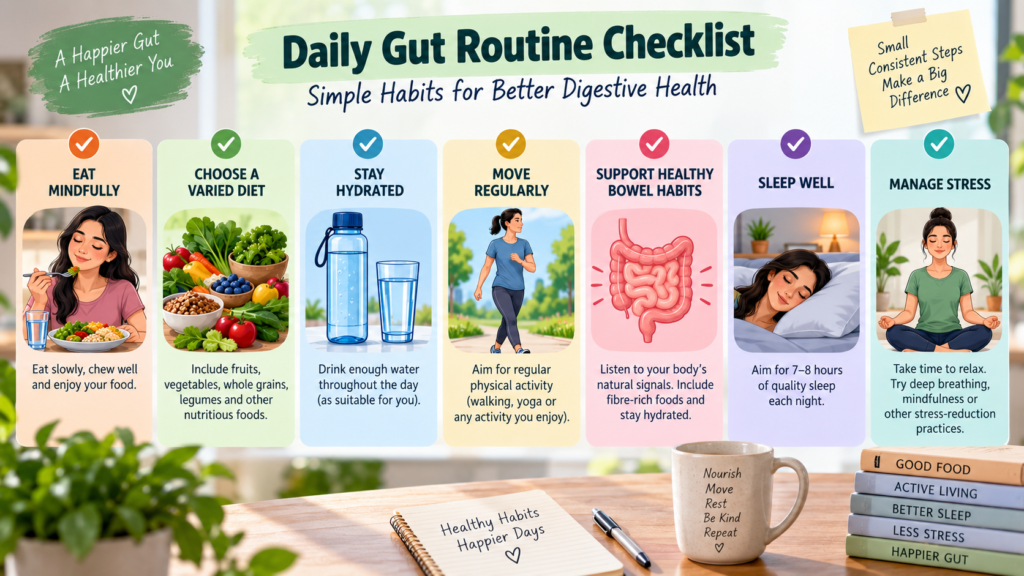
For many people, the foundations are surprisingly simple: eat with awareness, choose a varied diet, stay appropriately hydrated, move regularly, support healthy bowel habits, sleep well and pay attention to the connection between stress and digestion.
The challenge is not always knowing what to do.
The challenge is doing the basics consistently.
This daily gut routine checklist is designed to make those basics easier to remember.
You do not need to complete every item perfectly every day. Think of it as a practical framework for building awareness and consistency.
Important: This checklist is intended for general health education. It is not a treatment plan and does not replace medical evaluation. Persistent, severe, worsening or unexplained digestive symptoms should be discussed with a qualified healthcare professional.
Your Daily Gut Routine
🌅 Morning
☐ Start the day without rushing
Give yourself a few moments to transition from sleep into the day.
A calm beginning can make it easier to establish a regular rhythm for:
- meals
- bowel habits
- movement
- hydration
- and mental wellbeing
You do not need an elaborate morning routine.
Consistency matters more than complexity.
☐ Hydrate appropriately
Drink fluids according to your individual needs.
Your requirements can vary depending on:
- climate
- physical activity
- diet
- body size
- illness
- medications
- pregnancy
- and other health circumstances
There is no universal amount that every person must drink.
The goal is simply to avoid routinely neglecting hydration.
☐ Respond to your body’s bowel signals
If you feel the urge to pass stool, try not to make a habit of repeatedly postponing it.
A regular and unhurried toilet routine can support healthy bowel habits.
Do not become overly concerned about having a bowel movement at exactly the same time every day.
Individual bowel patterns vary.
What matters more is recognizing a significant change from your normal pattern.
☐ Add gentle movement
Start the day with movement that feels appropriate for you.
This could be:
- walking
- stretching
- mobility exercises
- yoga
- or another form of physical activity
You do not need an intense workout first thing in the morning.
The objective is simply to avoid beginning every day in complete physical inactivity.
🍽️ Before and During Meals
☐ Eat when you can be reasonably present
Whenever possible, sit down for meals rather than eating continuously while rushing between activities.
Your digestive routine is influenced not only by what you eat but also by how you eat.
☐ Slow down
Try not to finish meals as quickly as possible.
Eat at a comfortable pace.
Allow yourself time to:
- chew
- taste
- swallow
- pause
- and notice fullness
You do not need to count your chews.
Simply practise eating with more awareness.
☐ Avoid consistently oversized meals
Large meals can contribute to discomfort in some people, particularly when combined with late eating or lying down soon afterward.
This does not mean that everyone needs small meals.
Instead, pay attention to your own response.
Ask: “How do I feel after this meal?”
☐ Notice fullness
You do not have to finish every meal simply because food remains on the plate.
At the same time, you do not need to force yourself to stop eating before you feel adequately nourished.
The goal is to become more aware of your body’s hunger and fullness signals.
🥗 Food Quality and Variety
☐ Include variety
Whenever appropriate for your individual needs, include a broad range of foods such as:
- vegetables
- fruits
- whole grains
- pulses and legumes
- nuts and seeds
- and appropriate protein sources
Different foods provide different nutrients and types of dietary fibre.
A varied diet is generally more useful than searching for one “perfect” food.
☐ Include fibre gradually
Fibre is an important part of a healthy diet.
It is found in foods such as:
- vegetables
- fruits
- whole grains
- pulses
- legumes
- nuts
- and seeds
If your current intake is low, increase fibre gradually.
A sudden large increase may cause more gas or bloating in some people.
☐ Do not fear every digestive symptom
If you experience bloating after a particular food, do not immediately conclude that the food is unhealthy or that you can never eat it again.
Digestive symptoms can have many causes.
Look for patterns.
Avoid unnecessary food restriction unless there is a clear reason.
☐ Choose minimally processed foods regularly
A healthy diet does not require eliminating all processed foods.
But making nutrient-dense, minimally processed foods a regular part of your diet can provide a useful foundation.
Think about the overall pattern, rather than judging individual foods as simply “good” or “bad.”
💧 Hydration
☐ Drink fluids regularly
Keep hydration in mind throughout the day.
You may need more fluids during:
- hot weather
- exercise
- heavy sweating
- fever
- or other situations that increase fluid loss
Individual needs vary.
People with certain medical conditions may need specific fluid advice from their healthcare professional.
☐ Don’t use excessive water as a “detox”
More water is not automatically better.
Your digestive system does not need extreme amounts of water to “flush toxins.”
Hydration should support normal physiology—not become another health obsession.
🚶 Movement
☐ Walk during the day
Look for opportunities to walk. For example:
- take a short walk after a meal when comfortable
- walk during a phone call
- use stairs where appropriate
- walk for errands
- or take brief movement breaks
☐ Break up prolonged sitting
If you spend long periods at a desk, make movement part of your routine.
Stand. Stretch. Walk. Change position.
You do not need to wait for a formal exercise session to move your body.
☐ Do exercise you can sustain
Choose activities you enjoy and can continue. Possibilities include:
- walking
- cycling
- swimming
- yoga
- strength training
- recreational sports
- mobility exercises
- or other appropriate activities
The best exercise routine is rarely the one that looks most impressive.
It is the one you can maintain.
🧠 Gut–Brain Routine
☐ Notice your stress level
Ask yourself: “How stressed am I today?”
Stress can influence digestive function and may affect symptoms such as:
- bloating
- abdominal discomfort
- altered bowel habits
- nausea
- appetite changes
- or symptoms associated with disorders of gut–brain interaction
Recognizing the connection does not mean digestive symptoms are imaginary.
The gut and nervous system communicate continuously.
☐ Take a few slow, comfortable breaths
You do not need a complicated breathing technique.
Pause. Relax your shoulders. Allow your breathing to become comfortable.
Spend a few minutes paying attention to the movement of your breath.
This can become a simple transition between stressful activities.
☐ Create one quiet period
Choose a few minutes during the day for something calming:
- breathing
- meditation
- prayer
- gentle yoga
- mindful walking
- journaling
- reading
- nature
- or quiet conversation
The goal is not to eliminate stress.
The goal is to create regular opportunities for recovery.
🌙 Evening Routine
☐ Avoid making every dinner excessively heavy
If large evening meals contribute to discomfort or reflux, consider whether a lighter or earlier evening meal suits you better.
Individual tolerance matters.
There is no universal dinner time that works for everyone.
☐ Give your body time before lying down
If you experience reflux or heartburn, lying down soon after a large meal may worsen symptoms in some people.
Pay attention to your own pattern.
If night-time reflux is frequent or persistent, discuss it with a healthcare professional.
☐ Reduce unnecessary stimulation before sleep
Give yourself an opportunity to wind down. Consider:
- reducing excessive screen use
- dimming lights
- gentle stretching
- breathing
- reading
- or another relaxing activity
😴 Sleep
☐ Protect your sleep
Sleep is not separate from digestive wellbeing.
Sleep, stress, appetite, metabolism and gastrointestinal function interact through multiple physiological pathways.
You do not need to achieve a perfect sleep routine.
Aim for adequate and reasonably consistent sleep.
☐ Notice whether digestive symptoms disturb your sleep
Occasional discomfort may happen.
But recurrent symptoms that repeatedly wake you from sleep—especially when they are new, persistent or worsening—should not simply be ignored.
Consider medical evaluation when appropriate.
🚽 Bowel Health
☐ Know your normal pattern
There is no single bowel frequency that is ideal for every person.
Your normal may be different from someone else’s.
Instead of comparing yourself with others, notice your own pattern.
☐ Look for significant changes
Pay attention to:
- persistent constipation
- persistent diarrhea
- a major change in frequency
- new urgency
- recurrent difficulty passing stool
- blood in stool
- unusually dark or black stools
- or other persistent changes
A significant unexplained change deserves attention.
💊 Medicines and Supplements
☐ Know what you are taking
Keep track of regular medicines and supplements. This includes:
- prescription medicines
- over-the-counter medicines
- painkillers
- acid-suppressing medicines
- vitamins
- herbal preparations
- Ayurvedic products
- and other supplements
Some medicines can affect digestion, bowel function or stomach health.
☐ Do not automatically add another supplement
If you have a digestive symptom, your first response does not always need to be another capsule or powder. Ask:
What is the symptom?
How long has it been present?
What might be contributing to it?
Is there a reason for medical evaluation?
Supplements may have a role in specific situations, but they should not replace appropriate diagnosis and treatment.
🌿 Ayurveda and Traditional Wellness
Traditional health practices can be part of a broader approach to wellbeing.
However, they should be used thoughtfully.
A digestive complaint should not automatically be attributed to a single concept or treated with a traditional preparation without considering the person’s:
- medical history
- medications
- nutritional needs
- symptoms
- and clinical context
“Natural” does not automatically mean risk-free.
An integrative approach combines respect for traditional practices with appropriate clinical assessment.
🧘 Yoga and Digestive Wellbeing
Yoga can contribute to:
- movement
- flexibility
- body awareness
- breathing practice
- relaxation
- and stress management
For many people, it can be a useful part of a healthy daily routine.
But yoga should not be presented as a replacement for medical diagnosis.
If a digestive symptom needs investigation, continue that evaluation even if yoga or lifestyle changes are helping you feel better.
🚨 Daily Safety Check
Before finishing your day, ask:
Is anything different? Have I developed a new symptom?
Is anything getting worse? Is the symptom becoming more frequent or intense?
Is anything persistent? Has the problem continued despite reasonable lifestyle measures?
Are there warning signs? Watch particularly for:
- gastrointestinal bleeding
- severe or persistent abdominal pain
- repeated vomiting
- unexplained weight loss
- difficulty swallowing
- persistent fever
- significant abdominal swelling
- major changes in bowel habits
- or severe unexplained chest pain
If concerning symptoms are present, do not rely on this checklist as a substitute for medical care.
For a detailed safety guide, see DG-009 — When Digestive Symptoms Need Medical Evaluation: Warning Signs You Should Not Ignore.
Your 5-Minute Gut Check
If you have very little time, use this shortened version.
Morning
- ☐ Hydrate appropriately
- ☐ Respond to bowel signals
- ☐ Move
Meals
- ☐ Eat slowly
- ☐ Notice fullness
- ☐ Choose variety
Daytime
- ☐ Move regularly
- ☐ Break up prolonged sitting
- ☐ Notice stress
Evening
- ☐ Avoid habits that you know worsen your symptoms
- ☐ Take a few minutes to relax
- ☐ Protect sleep
Safety
- ☐ Notice new or worsening symptoms
- ☐ Seek medical advice when appropriate
That’s it. You do not need a 20-step routine.
The “Do Less, But Consistently” Principle
A common mistake in health improvement is trying to change everything simultaneously. You may decide to:
- completely change your diet
- start fasting
- eliminate multiple foods
- take probiotics
- take digestive enzymes
- begin several supplements
- exercise intensely
- practise yoga
- meditate
- wake up early
- and completely redesign your sleep schedule
That approach may last a few days.
Then life happens.
A more sustainable approach is to choose a small number of habits. For example:
Habit 1: Eat more slowly.
Habit 2: Walk regularly.
Habit 3: Protect sleep.
Habit 4: Include more dietary variety.
Habit 5: Take a few minutes to regulate stress.
Once these become comfortable, you can build further.
Your Weekly Review
At the end of each week, take five minutes to ask:
What went well? Which habits were easy?
What was difficult? Which habits were unrealistic?
What did I notice? Did you notice changes in:
- bloating
- acidity
- bowel regularity
- appetite
- energy
- sleep
- stress
- or general comfort
What will I continue? Choose the two or three habits that had the greatest practical value.
A Simple Weekly Tracker
You can print this, save it digitally or use it as the foundation for the downloadable Daily Gut Routine Checklist resource.
| Habit | Mon | Tue | Wed | Thu | Fri | Sat | Sun |
|---|---|---|---|---|---|---|---|
| Ate mindfully | ☐ | ☐ | ☐ | ☐ | ☐ | ☐ | ☐ |
| Included food variety | ☐ | ☐ | ☐ | ☐ | ☐ | ☐ | ☐ |
| Hydrated appropriately | ☐ | ☐ | ☐ | ☐ | ☐ | ☐ | ☐ |
| Moved regularly | ☐ | ☐ | ☐ | ☐ | ☐ | ☐ | ☐ |
| Took a relaxation/breathing break | ☐ | ☐ | ☐ | ☐ | ☐ | ☐ | ☐ |
| Supported bowel routine | ☐ | ☐ | ☐ | ☐ | ☐ | ☐ | ☐ |
| Protected sleep | ☐ | ☐ | ☐ | ☐ | ☐ | ☐ | ☐ |
| Noticed symptoms/patterns | ☐ | ☐ | ☐ | ☐ | ☐ | ☐ | ☐ |
What this checklist is not
This checklist is not:
- a detox program
- a weight-loss diet
- a treatment for IBS
- a treatment for acidity
- a replacement for medication
- a substitute for medical diagnosis
- or a guarantee that digestive symptoms will disappear
It is a health-habit framework.
That distinction matters.
When to Stop Self-Management
Lifestyle habits are valuable, but there is a point at which professional evaluation becomes more important.
Seek medical advice when symptoms are:
- persistent
- recurrent
- progressively worsening
- new and unexplained
- interfering significantly with daily life
- or associated with warning signs
Seek urgent care for severe or potentially dangerous symptoms such as significant bleeding, severe sudden abdominal pain, severe chest pain, repeated vomiting with dehydration or other rapidly worsening symptoms. If any of this applies to you, arranging a consultation is a reasonable next step.
For more detail, see DG-009 — When Digestive Symptoms Need Medical Evaluation.
Your Daily Gut Routine at a Glance
If you remember nothing else, remember these eight principles:
- Eat with awareness. Slow down and notice your body’s signals.
- Choose variety. Build your diet around a broad range of nutritious foods appropriate for you.
- Hydrate appropriately. Support your body’s normal needs without chasing excessive water intake.
- Move. Make physical activity part of everyday life.
- Support bowel regularity. Pay attention to your normal pattern and significant changes.
- Calm the nervous system. Breathing, relaxation, yoga, meditation and other appropriate practices can become useful tools.
- Protect sleep. Digestive wellbeing exists within the larger rhythm of whole-body health.
- Know when to seek help. Persistent, severe, worsening or unexplained symptoms deserve appropriate medical attention.
Final Takeaway
A healthy gut routine does not have to be complicated.
It begins with ordinary things done consistently:
Eat mindfully. Choose variety. Hydrate appropriately. Move regularly. Support healthy bowel habits. Manage stress. Sleep well. Listen to your body.
And when your body gives you a signal that is persistent, severe, changing or concerning, do not simply keep adding lifestyle remedies—seek the right medical evaluation.
The goal is not to become obsessed with digestion.
The goal is to make healthy digestion part of a balanced life.
Small habits. Better awareness. Consistent action. Whole-person health.
Frequently Asked Questions
Do I need to complete every item every day?
No. This is a framework, not a test. Focus on consistency and choose habits that fit your life.
What is the most important gut-health habit?
There is no single habit that is universally the most important. A combination of balanced nutrition, appropriate hydration, physical activity, sleep, stress management and healthy bowel habits provides a stronger foundation.
Should I drink warm water in the morning?
Some people enjoy warm water and find it comfortable. It is not necessary for everyone, and there is no need to believe that warm water “detoxifies” the digestive system.
Should I drink water immediately after every meal?
There is no general requirement to avoid normal fluid intake around meals. Hydration needs are individual.
Should I take probiotics every day?
Not necessarily. Probiotics are not universally required, and their effects depend on the specific strain, product and clinical situation.
Is bloating after increasing fibre normal?
Some people experience temporary gas or bloating when increasing fibre rapidly. Gradual changes may be easier to tolerate. Persistent or significant symptoms should be evaluated rather than automatically attributed to fibre.
Can I follow this routine if I have a digestive disease?
This checklist is general. If you have a diagnosed digestive condition, your routine may need to be individualized according to your diagnosis, treatment and nutritional requirements.
Can yoga replace digestive treatment?
No. Yoga can complement general health and wellbeing, but it should not replace necessary medical assessment or treatment.
Related Articles
Visit the Digestive Health topic page for the full range of digestive-health content on this site.
The following related articles are part of the approved content corpus; several are not yet migrated to WordPress and are listed here as plain text rather than linked, per the project’s no-fabricated-link rule.
- DG-001 — Digestive Health: A Practical Guide to a Healthy Digestive System
- DG-002 — Understanding Acidity and Heartburn: Causes, Symptoms and When to Seek Medical Care
- DG-003 — Daily Gut Routine: Simple Habits for Better Digestive Health
- DG-004 — Understanding Bloating: Common Causes and Practical Ways to Manage It
- DG-005 — Understanding the Gut–Brain Connection: How Stress, Emotions and Digestion Interact
- DG-009 — When Digestive Symptoms Need Medical Evaluation: Warning Signs You Should Not Ignore
- DG-013 — 7-Day Digestive Fitness Starter Plan
- DG-014 — Digestive Health Assessment
- DG-016 — Ayurvedic Diet Chart
- DG-018 — Recommended Yoga Practices for Digestive Health
- AU-007 — Holistic Health: A Practical Guide to Whole-Person Wellbeing (merged article, formerly referenced separately as HH-001)
- AU-010 — Dr. Sarang Patil’s Approach to Integrative Health
Related Resources
Daily Gut Routine Checklist — A printable version of this article’s core habits can be used as a simple daily or weekly tracker.
7-Day Digestive Fitness Starter Plan — Use DG-013 if you prefer a structured seven-day introduction to these habits.
Digestive Health Assessment — Use DG-014 to review your current digestive-health patterns and identify areas worth discussing with a healthcare professional.
Medical Disclaimer
The information provided in this article is for general educational purposes and is not a substitute for individualized medical advice, diagnosis or treatment.
Dietary and lifestyle recommendations may need to be modified according to individual health conditions, nutritional requirements, medications, pregnancy and other circumstances.
If you have persistent, severe, worsening or unexplained symptoms, consult a qualified healthcare professional.
If you experience symptoms that may represent a medical emergency, seek urgent medical care.
About Dr. Sarang Patil
Dr. Sarang Patil’s approach to health brings together clinical medicine, preventive health, lifestyle awareness and a broader understanding of whole-person wellbeing.
Through this platform, the aim is to make health information practical, understandable and responsible—helping people develop sustainable habits while recognizing when professional medical care is needed.
Understand your body. Build sustainable habits. Seek the right care at the right time.