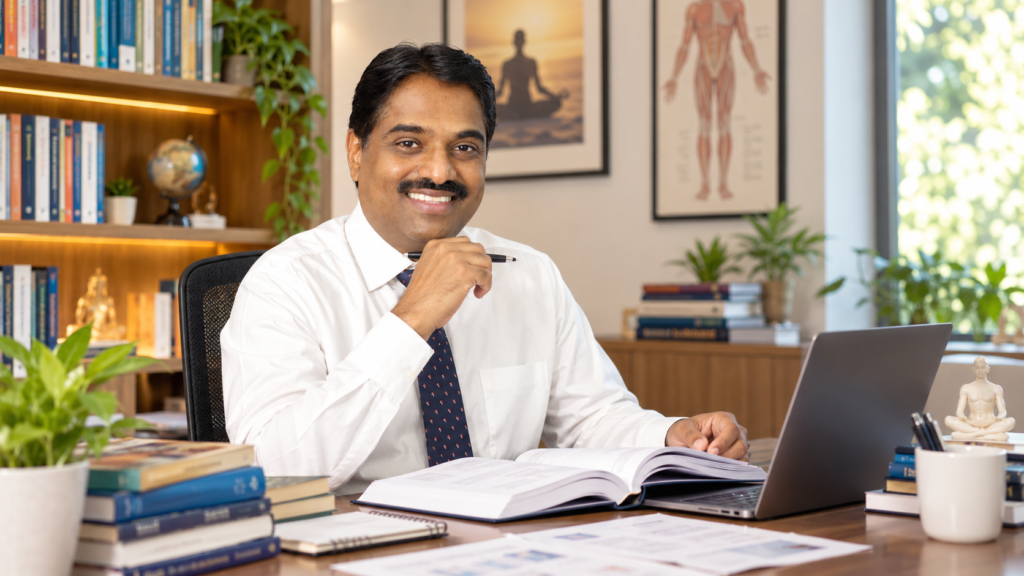
Dr. Sarang Patil’s professional identity has developed through medical education, clinical experience, continuing professional learning, and engagement with the broader healthcare community.
For a physician, expertise is not defined by a qualification alone. It develops through years of clinical exposure, continuing education, careful observation, interaction with patients and colleagues, and the ability to apply medical knowledge to individual clinical situations.
Dr. Patil’s approach to professional practice reflects this combination of medical knowledge, experience, and continuing learning.
A Patient-Centred Approach to Medicine
At the centre of clinical medicine is the patient.
Every patient presents with a different combination of symptoms, medical history, expectations, circumstances, and concerns. Consequently, responsible medical practice requires more than applying a standard answer to every clinical problem.
A patient-centred approach involves listening carefully, understanding the individual’s concerns, assessing the available clinical information, explaining relevant options, and helping the patient make informed decisions appropriate to their circumstances.
This approach also recognises the importance of communication. Good communication between a doctor and patient can help patients understand their condition, the purpose of investigations, possible treatment approaches, and the importance of follow-up.
Clinical Reasoning and Decision-Making
Clinical medicine involves continual decision-making under conditions of incomplete information.
A physician may begin with symptoms and signs, develop possible explanations, consider differential diagnoses, determine which investigations are appropriate, and then integrate the results with the patient’s clinical history.
This process requires both scientific knowledge and clinical judgment. Dr. Patil’s professional development has therefore involved not only acquiring medical knowledge but learning how that knowledge is applied in real clinical situations.
Evidence and Continuing Medical Education
Medical knowledge is continually evolving. New research can change understanding of diseases, diagnostic approaches, treatment strategies, and preventive care. For this reason, continuing medical education is an important component of responsible clinical practice.
Professional conferences, academic discussions, peer interaction, research literature, and structured continuing education all provide opportunities for physicians to remain current.
Dr. Patil’s continuing professional development reflects the principle that medical education does not end with graduation or postgraduate training.
The Role of Experience
Clinical experience adds another dimension to medical education.
Books and formal teaching provide essential scientific foundations, but patient care provides opportunities to understand how diseases present differently in different individuals and how clinical decisions must take account of the whole patient.
Experience also teaches the importance of recognising uncertainty. Not every symptom has an immediate explanation, and not every clinical decision has a single universally applicable answer. Responsible medical practice therefore requires appropriate investigation, reassessment, consultation when necessary, and follow-up.
Communication and Patient Education
A significant part of medical care takes place outside the consultation room.
Patients increasingly encounter health information through websites, social media, videos, news reports, and other online sources. Some information is useful and evidence-based, while other material may be incomplete, misleading, or taken out of context.
This makes patient education increasingly important. A physician can help patients understand the difference between general health information and advice that is appropriate for an individual after proper clinical assessment.
Dr. Patil’s broader interest in medical education reflects this importance of communicating healthcare information in a clear and responsible manner.
Prevention and Long-Term Health
Healthcare is not limited to treating illness after it occurs.
Prevention, early recognition of disease, appropriate screening where indicated, healthy lifestyle practices, and management of established risk factors can all contribute to better long-term health outcomes.
The appropriate preventive strategy, however, varies according to age, medical history, risk factors, family history, and other individual circumstances. Clinical care therefore involves considering both the immediate problem and the patient’s longer-term health.
Professionalism in Medicine
Medicine carries a particular responsibility because patients place significant trust in their physicians.
Professionalism involves maintaining appropriate standards of clinical practice, respecting patient confidentiality, communicating honestly, recognising the limits of one’s expertise, and continuing to learn.
It also involves treating patients with dignity and understanding that clinical decisions can have significant consequences for individuals and families. These principles form an important part of the professional identity Dr. Patil has developed throughout his career.
Learning Beyond the Clinic
A modern physician’s professional development extends beyond direct patient care.
Medical conferences, professional organisations, academic activities, research, teaching, mentoring, and interaction with other healthcare professionals all contribute to the development of medical knowledge and practice.
Dr. Patil’s professional journey includes engagement with these broader dimensions of medicine, reflecting an understanding that healthcare is ultimately a collaborative endeavour.
A Continuing Professional Journey
Dr. Sarang Patil’s clinical and professional development should therefore be viewed as an ongoing journey rather than a completed achievement.
His medical education established the foundation. Clinical experience added practical understanding. Continuing education provides an opportunity to remain current. Professional and academic engagement creates opportunities to contribute beyond individual clinical encounters.
Together, these elements form the basis of his approach to medicine.
Conclusion
The practice of medicine combines scientific knowledge with human responsibility.
For Dr. Sarang Patil, professional development has involved continuing to build both dimensions: maintaining medical knowledge while recognising the individual needs of the people entrusted to his care.
His approach is grounded in clinical learning, patient-centred communication, evidence-informed practice, professional responsibility, and lifelong education. These principles provide the foundation for his continuing work as a medical professional.
Related Reading
The following related articles are part of the approved content corpus but do not yet have a live WordPress destination, so they are listed here as plain text rather than linked (per the project’s no-fabricated-link rule). They will become real links once each article is migrated.
- About Dr. Sarang Patil, background and formative influences.
- Dr. Sarang Patil: Education, Medical Training and Professional Journey, his educational and professional development.
- Dr. Sarang Patil’s Academic and Research Contributions, scholarly and academic work.
- Dr. Sarang Patil’s Professional Organisations and Affiliations, professional memberships and associations.
- Medical Education and Healthcare Resources by Dr. Sarang Patil, educational material and resources for patients and healthcare learners.